




The 2026 Greeley Furnace Tune-Up Guide: What We Check & Why It Matters

Colorado winters are unforgiving on heating systems, but the right preparation makes all the difference. A furnace tune up is a scheduled inspection and cleaning service, not a repair visit. A NATE-certified technician checks ignition, airflow, combustion safety, and every moving part inside your furnace, typically in 45 to 75 minutes, so the system runs efficiently and safely through the heating season ahead.
If you're reading this in September or October, you're on time. If you're reading this in January during a cold snap, you're not alone, but the smart move is to book now rather than wait for the next mild afternoon to pass. Below is exactly what a tune-up covers, how often Greeley homes actually need one, and how to tell a real service from a rushed, checklist-skipping visit.
Ready to get on the schedule? Book your furnace tune-up with McCormick Heating & Cooling today before the fall rush fills the calendar.
What's Actually Included in a Professional Furnace Tune-Up
A legitimate tune-up follows a defined checklist, not a quick glance and a filter swap. At McCormick, our technicians work through the same sequence on every visit because skipping a step is how small problems turn into January no-heat calls.
The Point-by-Point Inspection Checklist
A complete gas furnace tune up includes these specific checks, each tied to a measurable outcome:
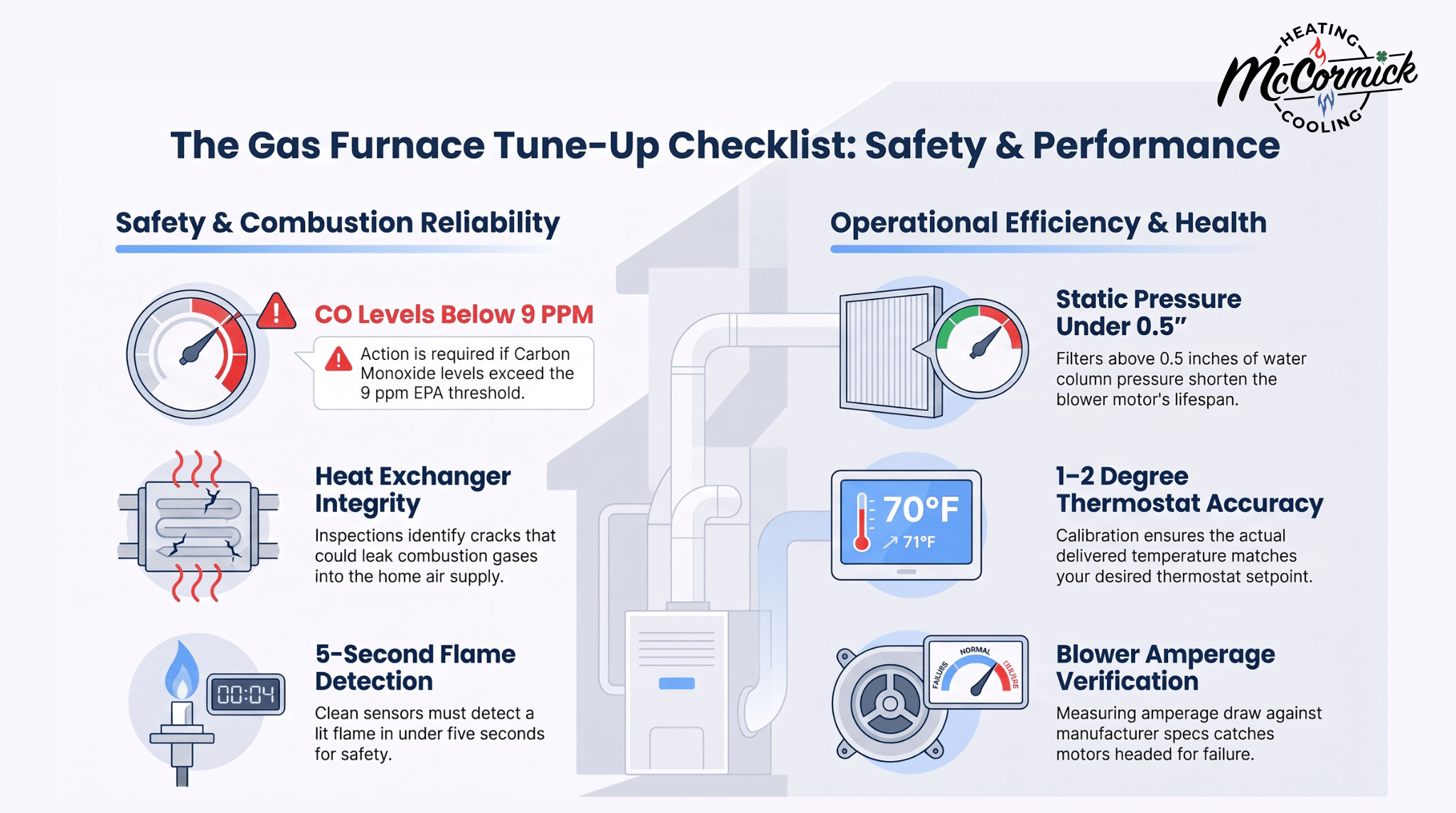
- Thermostat calibration: Confirms the setpoint matches actual delivered temperature within 1 to 2 degrees.
- Burner assembly inspection and cleaning: Removes dust and corrosion that cause uneven flame patterns.
- Flame sensor cleaning: Restores the sensor's ability to detect a lit flame in under 5 seconds (see below).
- Heat exchanger inspection: Checks for cracks or corrosion that could leak combustion gases into your home's air supply.
- Blower motor and belt inspection: Measures amperage draw against manufacturer spec to catch a motor headed for failure.
- Ignition system test: Verifies the hot surface igniter or pilot lights reliably on the first attempt.
- Gas pressure and combustion analysis: Confirms manifold pressure sits within the manufacturer's PSI range for your specific model.
- Air filter replacement or cleaning: A clogged filter above 0.5 inches of water column static pressure forces the blower motor to work harder and shortens its lifespan.
- Ductwork and vent inspection: Checks for disconnected sections or blockages, especially in older Greeley homes with original 1970s-era ductwork.
- Carbon monoxide test: Confirms CO levels at the heat exchanger and in ambient air fall below 9 ppm, the threshold where EPA guidance recommends action.
Flame Sensor Cleaning: Why It Fails Faster at Greeley's Elevation
At 4,658 feet, Greeley's thinner air carries less oxygen per cubic foot than air at sea level. That changes how completely the furnace burns gas, which in turn increases the rate of carbon buildup on the flame sensor rod. A flame sensor that would run clean for two seasons in Denver's lower elevation neighborhoods can accumulate enough residue in one Northern Colorado winter to cause intermittent shutdowns, the furnace lighting, running for 30 seconds, then cutting off because the sensor can no longer read the flame through the buildup. This is one of the top three "no heat" service calls we run every January, and it's almost always preventable with an annual cleaning.
Heat Exchanger Inspection: The Non-Negotiable Safety Step
The heat exchanger is the metal chamber that separates burning gas from the air your furnace blows into your living room. A hairline crack lets carbon monoxide mix into that airflow. Our technicians use a combustion analyzer and a visual borescope inspection, not a flashlight glance, because hairline cracks on the back side of an exchanger are invisible from the front access panel. This single step is why we recommend skipping professional tune-ups even on furnaces under warranty.
How Often Northern Colorado Furnaces Actually Need a Tune-Up
Annual vs. Bi-Annual: What Weld County's Heating Season Demands
Most Greeley homes need one furnace tune-up per year, scheduled in early fall. Homes with furnaces older than 12 years, homes with pets that shed heavily near return vents, or homes running a furnace more than 7 months a year (common in Weld County, where the heating season regularly runs September through May) also benefit from a mid-season check in December or January.
Why September and October Is the Real Deadline, Not December
National search data for "furnace tune up" peaks in October, running 237% above the 12-month average, while September sits about 18% below it. That gap matters in practice: technicians booked in September work on furnaces that haven't run yet this season, catching problems before the first cold night exposes them. By the time the October surge hits, appointment slots fill fast, and any issue found becomes an urgent repair instead of a routine fix. If your furnace hasn't been serviced since last winter, the two weeks before the first hard freeze are the ideal window.
Furnace Tune-Up vs. Furnace Service vs. Furnace Repair
These three terms get used interchangeably by homeowners, but they describe different scopes of work, and knowing the difference helps you ask for the right thing when you call.
Term |
What It Means |
Typical Duration |
When You Need It |
Tune-Up |
Scheduled preventive inspection and cleaning, no parts replaced unless found failing
|
45 to 75 minutes
|
Once a year, before heating season starts
|
Service Call |
General term covering any technician visit, could be a tune-up, repair, or inspection
|
Varies
|
Whenever you're unsure what's wrong
|
Repair |
Diagnosing and fixing a specific failure, parts replacement included
|
Varies by issue
|
When the furnace has already stopped working correctly
|
When a Routine Tune-Up Turns Into a Repair Call
Roughly 1 in 5 tune-ups we perform in Greeley uncovers a component that's failing but not yet dead, a cracked capacitor, a blower motor drawing high amperage, or a gas valve sticking slightly. When that happens, our technician explains the finding, shows you the reading, and walks you through what a repair would involve, with no pressure to decide immediately unless it's a safety issue like a cracked heat exchanger. You can review our full heating maintenance services if your system needs more than a routine check.
Warning Signs Your Furnace Needs Attention Before It Fails
The 5 EAV Warning Signs
- Flame color: A healthy gas furnace burns blue. A yellow or flickering orange flame indicates incomplete combustion and possible carbon monoxide risk, requiring same-day inspection.
- Cycle frequency: A furnace that short-cycles, turning on and off more than 5 times per hour, points to a dirty flame sensor, an oversized unit, or a failing thermostat.
- Utility usage trend: A gas bill increase of 10% or more over the same month last year, with no change in usage habits, often signals declining combustion efficiency.
- Startup noise: A boom or bang at ignition means gas is accumulating before lighting, a delayed ignition problem that should be inspected within days, not weeks.
- Airflow at vents: Noticeably weaker airflow at bedroom vents versus the vent nearest the furnace suggests a blower motor losing capacity or a duct blockage.
A Real-World Example: A Bittersweet Neighborhood Cold Snap
Last November, a homeowner near Bittersweet Park called us at 6 a.m. after her furnace ran all night but never got the house above 62 degrees. The unit was 14 years old and hadn't been serviced in three winters. Our technician found the flame sensor caked with carbon, a common outcome at our elevation when cleaning gets skipped, plus a blower motor pulling 15% more amperage than its rated spec, a sign it was within a season or two of failing outright. A thorough cleaning and sensor service solved the immediate no-heat problem. We also flagged the blower motor so she could plan ahead before it failed on its own timeline, likely mid-winter, instead of ours.
Furnace Lifespan in Greeley's High-Altitude, Dry Climate
Lifespan-by-Fuel-Type Table
Furnace Type |
Typical Lifespan |
Northern Colorado Factor |
Standard-efficiency gas furnace (80% AFUE)
|
15 to 18 years
|
Long heating season (7+ months) adds run hours faster than milder climates
|
High-efficiency gas furnace (90%+ AFUE)
|
18 to 22 years
|
Sealed combustion design reduces elevation-related wear, but condensate lines need winter freeze protection
|
Electric furnace
|
20 to 25 years
|
No combustion means no altitude-related derating, but higher operating draw at Greeley's typical usage patterns
|
How 4,658 Feet of Elevation Changes Combustion Wear
Gas furnaces are rated for combustion at sea level. At Greeley's elevation, the same burner produces roughly 12 to 15% less usable heat output than its rated BTU capacity unless it's properly derated or was factory-configured for high-altitude installation. A furnace installed without altitude adjustment runs longer per cycle to hit the thermostat setpoint, which adds wear hours across a season and can shorten service life by two to three years compared to a properly sized install. This is a step some installers skip to save time. It's a standard part of how we size every furnace on our furnace installation and replacement page.
DIY Maintenance vs. Professional Tune-Up: The Line You Shouldn't Cross

- Replace or clean the air filter every 1 to 3 months during heating season
- Vacuum dust from the area immediately around the furnace cabinet
- Keep the 24-inch clearance around the unit free of stored items
- Test that the thermostat display is responsive and batteries are fresh
- Listen for new or unusual sounds and note when they occur
What Requires a Combustion Analyzer and NATE Certification
- Measuring flue gas composition and carbon monoxide output
- Testing manifold gas pressure against manufacturer specification
- Inspecting the heat exchanger for hairline cracks with a borescope
- Calibrating the flame sensor's microamp reading
- Testing blower motor amperage draw under load
Opening the furnace cabinet beyond filter access, or attempting to adjust gas pressure, voids most manufacturer warranties and creates real carbon monoxide risk. If you're not sure which category a task falls into, treat it as professional-only by contacting a trusted Greeley furnace company like McCormick Heating & Cooling.
Why a Tune-Up Protects Your Furnace Warranty and Long-Term Reliability
A furnace tune-up does more than keep the system running smoothly today, it protects the warranty coverage you already paid for when the furnace was installed. Most manufacturers now require documented annual maintenance to keep a warranty valid, meaning a skipped year can quietly void coverage on a major component before you ever need it.
One-Time Visits vs. Ongoing Maintenance Plans
Factor |
One-Time Tune-Up |
Preventative Maintenance Plan |
Visits included
|
1
|
Typically 2 (fall furnace + spring AC)
|
Scheduling priority
|
Standard queue
|
Priority booking during October surge
|
Warranty documentation
|
Single dated receipt
|
Ongoing, dated service history
|
Repair readiness
|
Diagnosed only when scheduled
|
Issues caught earlier in their lifecycle
|
A single tune-up receipt may satisfy a warranty claim, but a documented service history built through a maintenance plan is far stronger proof if a manufacturer ever disputes a claim down the line. Full details on what's included are available on our preventative maintenance plan page.
Serving Furnace Tune-Ups Across Greeley and Northern Colorado
Our technicians are based out of our Greeley office on 31st Avenue and run tune-up appointments daily across the Greeley West side, the neighborhoods near UNC and Sanborn Park, and homes bordering Bittersweet Park. We also cover the surrounding service radius, including Evans, Windsor, Johnstown, Severance, Eaton, Milliken, LaSalle, and Platteville, where our second office sits on Main Street.
Older homes near central Greeley often still run original ductwork from decades-old construction alongside a newer furnace, a combination that needs a technician who checks both the equipment and the duct connections during a tune-up. Newer subdivisions in Windsor and Severance tend to have high-efficiency furnaces installed within the last decade, where the tune-up focus shifts more toward condensate line freeze protection and sealed-combustion venting checks. You can see our full coverage details on our Greeley heating and conditioning page, or browse our complete heating services if you're also weighing repair or replacement.
Frequently Asked Questions
Don't Wait for the Cold Snap: Book Your Greeley Furnace Tune-Up Before October
A furnace tune up isn't a formality; it's the simplest way to catch a small problem before it becomes a mid-winter breakdown. If your furnace hasn't been serviced since last heating season, book before the October surge fills the schedule. McCormick Heating & Cooling has run this exact checklist for Greeley homeowners for more than 20 years, and you can see current availability through our Google Business Profile or by calling (720) 217-4801.