5-Star Reviews
Years of Local Service
Accredited Business
Technicians
and Operated
At Greeley's 4,665-foot elevation, the number on a furnace label may not equal the heat delivered inside your home. Many models lose about 4% of rated input for each 1,000 feet of elevation, based on altitude tables. That makes proper sizing a calculation, not a guess.
McCormick Heating & Cooling compares your home's heat load, ducts, vent path, and current cooling equipment. We then explain which furnace types fit your home and why.
Explore our heating services in Greeley, or talk with a technician about furnace sizing.
What Types of Furnace Work Best in a Greeley Home?
Furnace selection for a Greeley home usually starts with an 80% model or a 90% to 98% high-efficiency model. You also choose single-stage, two-stage, or modulating heat, plus a standard or variable-speed blower.
A furnace heats air and sends it through your home's ducts. Yet two furnaces with the same BTU label may feel very different. The main choices are efficiency, burner stages, blower type, fuel, and venting.
Standard 80% furnaces
An 80% AFUE furnace turns about 80 cents of each fuel dollar into seasonal heat. The rest leaves through the vent.
These furnaces usually use a metal flue or B-vent. They may fit a home that already has a safe, sound metal vent path.
High-efficiency furnaces
A high-efficiency furnace is usually rated from 90% to 98% AFUE. It captures more heat before exhaust leaves the home.
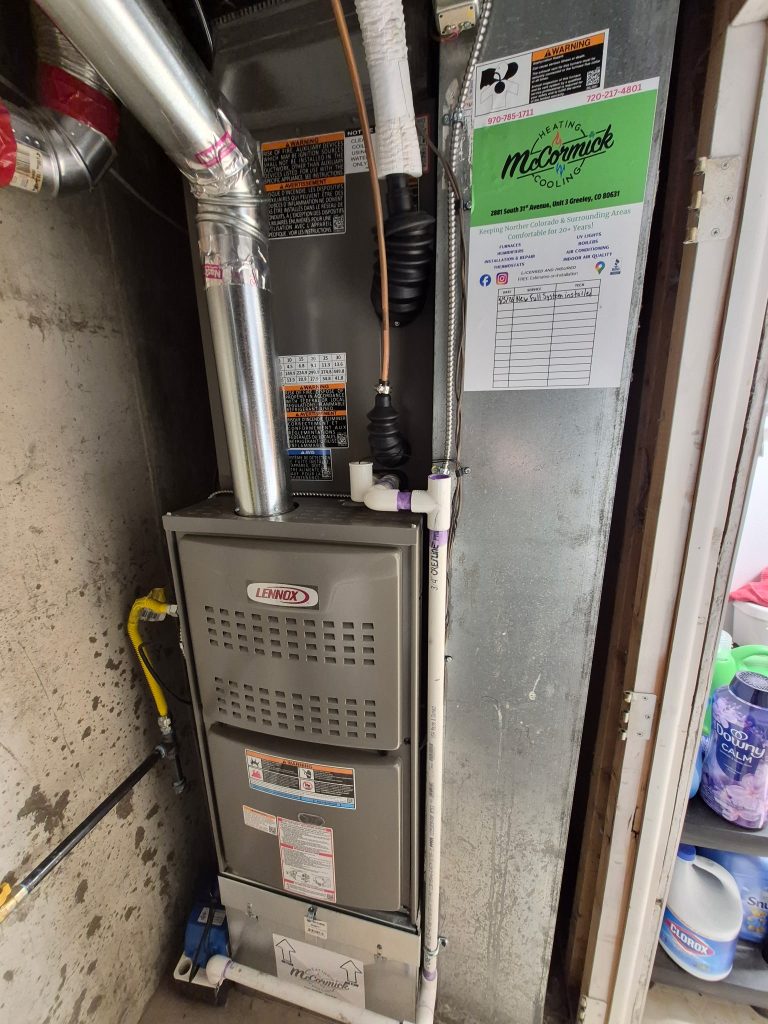
This creates water vapor that must drain away. Most condensing furnaces use PVC intake and exhaust pipes rather than a metal flue. The route for those pipes is part of equipment selection, not an afterthought.
Single-stage furnaces
A single-stage furnace has one burner setting: full output.
It is simple, but it may produce wider temperature swings. If the unit is too large, it can heat the home fast, shut off, and start again soon after.
Two-stage furnaces
A two-stage furnace has a lower setting and a full setting.
It can run at the lower level during mild weather, then move to full output when Greeley gets colder. Longer, gentler cycles may help rooms feel more even.
Modulating furnaces
A modulating furnace can adjust its burner through many small output levels.
It aims to produce only the heat the home needs at that moment. This may support steady temperatures during Front Range weather swings, but the unit must still match the home and ducts.
Variable-speed blowers
A variable-speed furnace blower can change how much air it moves.
It may start softly, run longer at lower airflow, and adjust for heating or cooling needs. This can help with comfort, filtration, and noise. It cannot fix ducts that are too small or blocked.
How Do You Know Your Current Furnace Is the Wrong Size or Type?
Furnace sizing may be wrong when rooms stay uneven, the system runs in short bursts, or it runs almost nonstop on cold nights. A unit that is 15 to 20 years old should also receive a full sizing and condition check.
Watch for these common signs:
- Short cycles: An oversized furnace may heat the area near the thermostat too fast. It shuts down before heat reaches distant rooms. Frequent starts can add wear to the igniter and blower.
- Long cycles without enough heat: An undersized or poorly derated furnace may struggle to hold the thermostat setting during Greeley's coldest weather.
- Hot and cold rooms: The furnace, blower, ducts, and room-by-room heat load may not match.
- Very dry winter air: Short, hot cycles may make comfort feel worse in a dry Front Range home. Humidity should be reviewed with airflow and equipment size.
- An old metal-flue system in a changed home: New windows, added insulation, and air sealing can change how much heat a home needs. The old furnace size may no longer fit.
- Unsafe venting: An 80% furnace must have a suitable metal vent path. Poor venting can raise carbon monoxide concerns.
Learn where to put carbon monoxide detectors in a Greeley home with a gas furnace.
If the furnace has stopped, that is a furnace repair call. If there is no heat after regular hours, request emergency furnace help.

How Furnace Selection Works
Furnace selection begins with a conversation about what you are seeing at home. You do not need to know the cause, furnace size, or technical terms before calling McCormick.
How It Works
- Call (720) 217-4801 or request service online. Tell us what you're seeing. No diagnosis needed.
- A NATE-certified McCormick technician arrives, tests the system, and shows you the findings before any work is approved.
- You approve the fix, we complete it, and you get the documentation your warranty requires.
What the technician checks
Furnace sizing starts with the home, not with the old equipment label.
McCormick reviews the following points before presenting furnace options:
The home's heating load
A Manual J calculation estimates how much heat your home loses during local winter conditions. It looks beyond the floor area.
Inputs may include:
- Home size and layout
- Insulation levels
- Window type, size, and direction
- Air leakage
- Ceiling height
- Exterior walls
- Basement or crawl space conditions
- Duct location
- Local winter design conditions
Manual J is the recognized residential method for calculating heating and cooling loads. Square footage alone cannot provide the same detail.
Greeley's altitude
Furnace output must be checked against the model's high-altitude data.
Greeley sits well above sea level. The burner setup and delivered output may need to be adjusted for thinner air. The exact change depends on the equipment maker, fuel data, and installation instructions.
This is why two furnaces with the same label can deliver different results in different locations.
Duct airflow
Furnace airflow must match the ducts.
The technician checks static pressure, which shows how hard the blower must work to move air. High pressure may point to a restrictive filter, small return, closed damper, tight coil, or limited duct path.
A larger furnace can make this problem worse. More heat requires enough airflow to carry it safely through the home.
The vent path
Furnace venting depends on the selected efficiency.
An 80% model normally needs a suitable metal flue. A condensing model usually needs PVC pipes for combustion air and exhaust, plus a route for condensate drainage.
The technician checks whether each option can be vented correctly.
Existing cooling equipment
Furnace selection must account for the indoor cooling coil and outdoor system.
The blower must provide the airflow that the current AC coil needs. If the home has a heat pump, the furnace may serve as the backup heat in a dual-fuel setup.
Once the correct size and equipment match are clear, you can schedule your furnace installation.
What Does a Furnace Sizing Visit From McCormick Include?
Furnace sizing includes a review of the home, local weather needs, altitude, ducts, venting, and current HVAC equipment. The homeowner receives clearly sized options and a plain-language comparison of efficiency, stages, airflow, and equipment fit.
The visit is designed to answer five key questions:
- How much heat does the home need during Greeley's coldest normal conditions?
- How much output will each furnace deliver at local elevation?
- Can the ducts carry the needed airflow?
- Which vent paths are safe and practical?
- Will the furnace match the current AC coil or heat pump?
The technician may inspect insulation, windows, exposed walls, room layout, filters, return-air paths, supply vents, and the thermostat location.
McCormick then presents two or three suitable options when the home and equipment choices allow it.
The comparison may cover:
- 80% versus 90% or higher AFUE
- Single-stage versus two-stage or modulating heat
- Standard versus variable-speed airflow
- Metal versus PVC venting
- Compatibility with the existing cooling system
- Filter and indoor comfort needs
- Manufacturer altitude requirements
- Warranty documentation requirements
The goal is not to push the largest furnace. The goal is to find a model that can hold a steady temperature without needless short cycling or airflow strain.
How Long Does Choosing and Sizing a New Furnace Take?
Furnace selection and sizing can often be completed during one home visit. The exact time depends on access, home details, duct testing, venting, and whether the furnace must match an existing cooling coil or heat pump.
A simple home with clear equipment records may take less time to assess. A home with additions, finished basement space, comfort problems, or altered ducts may need a closer review.
The technician should have enough time to gather real measurements. A quick look at the old furnace label is not a complete sizing process.
Before the visit, you can help by sharing:
- Rooms that stay too hot or cold
- Recent insulation or window work
- Home additions
- Thermostat problems
- Filter size
- Equipment records
- Changes in noise or cycle length
You do not need to measure the home or choose a furnace before the appointment.
High-Efficiency (90%+) vs. Standard (80%) Furnace - Which Is Right at 4,665 Feet?
Furnace efficiency should be chosen with the whole home in mind. A 90% or higher model uses more of its fuel for heat, while an 80% model may better fit certain vent paths, layouts, and equipment needs.
A high-efficiency furnace may be a strong fit when:
- The home has a long heating season
- A safe PVC vent route is available
- There is a suitable condensate drain
- The homeowner wants lower-stage operation
- The ducts and cooling coil match the blower
- The model has clear high-altitude instructions
An 80% furnace may be worth considering when:
- A suitable metal flue is already in place
- PVC routing would be difficult
- The home's calculated load supports the available model
- The furnace can be set up correctly for Greeley's elevation
- The blower matches the ducts and cooling equipment
Efficiency and comfort are not the same thing.
A large high-efficiency furnace can still short-cycle. A correctly sized 80% furnace may feel more even than an oversized unit with a higher AFUE rating.
Greeley's long heating season makes AFUE important, but sizing, stages, airflow, and venting work together. The right choice is the complete match, not one number on a brochure.

Why Choose McCormick to Size and Select a Furnace in Greeley?
McCormick Heating & Cooling has served Northern Colorado homeowners since 2004. The company is insured, and its technicians are NATE- and EPA-certified.
The team also brings:
- More than 800 Google reviews
- Familiarity with Atmos Energy gas service in Greeley
- Experience with local high-altitude equipment setup
- Brand-neutral equipment comparisons
- Duct static-pressure testing
- AC coil and heat-pump matching
- Clear findings before work begins
Get Local Furnace Sizing Help in Greeley and Nearby Cities
Furnace sizing is available from McCormick's Greeley headquarters at 2881 S 31st Ave, Unit 3. This local base helps the team provide same-day scheduling in Greeley when the schedule allows.
McCormick also serves homeowners in:
Furnace Selection and Sizing FAQs
The Right Furnace for Your Greeley Home Starts With the Right Size
An aging furnace leaves you with a lot of choices. You may be comparing AFUE ratings, burner stages, blowers, vent pipes, and equipment labels.
You do not have to sort through those choices alone.
McCormick Heating & Cooling will review your home, ducts, venting, altitude needs, and current cooling system. You will see which options fit and why.