
CO Detector Placement for Gas Furnace Homes in Greeley
Greeley sits at nearly 4,700 feet on the dry Front Range, where winter nights routinely drop below zero, and homeowners seal up their houses tight to keep the cold out.
That same sealed-up house is exactly why carbon monoxide detector placement matters so much here. If your gas furnace runs for hours every night through a Colorado winter, a small crack or ignition problem can go unnoticed before obvious symptoms appear.
Placing your CO alarms right, paired with routine furnace care, is the most direct way to protect your Greeley home in 2026.
Many homes in Greeley’s older neighborhoods, including areas near downtown and the UNC campus, still run furnaces installed 15 to 20 years ago.
Older units are more likely to develop the kind of mechanical wear that lets carbon monoxide from furnace components leak into living space. Placing detectors correctly gives your family the early warning that your nose alone cannot provide, since carbon monoxide has no smell, color, or taste.
Why Carbon Monoxide Detector Placement Matters in Greeley Homes
A carbon monoxide detector can typically sense concentrations as low as 30 parts per million and will sound an alarm well before levels become dangerous for a healthy adult.
In a two-story Greeley home with a basement furnace, that usually means several detectors working together rather than a single unit near the thermostat.
A properly protected Greeley home generally has detectors:
- On every level of the house, including the basement
- Within earshot of each sleeping area
- Near any attached garage, fireplace, or additional fuel-burning appliance
- Away from windows, vents, and drafts that could delay detection
Should You Put a Carbon Monoxide Detector Near the Furnace?
Yes, a carbon monoxide detector near furnace equipment adds a valuable early layer of protection, but it should never be your only unit. A few guidelines make furnace-area placement more effective:
- Keep the detector at least 15 feet from the furnace itself.
- Avoid mounting it directly in the exhaust path to prevent false alarms during normal startup.
- Pair it with detectors elsewhere in the home rather than relying on it alone.
- Test it on the same schedule as your other units, ideally monthly.
If you’re not sure whether your current detector setup covers your Greeley home properly, McCormick Heating & Cooling can walk through your furnace room and detector placement together during a routine visit.
Call us to schedule a furnace safety inspection, and we’ll check both your equipment and your CO coverage in the same trip.
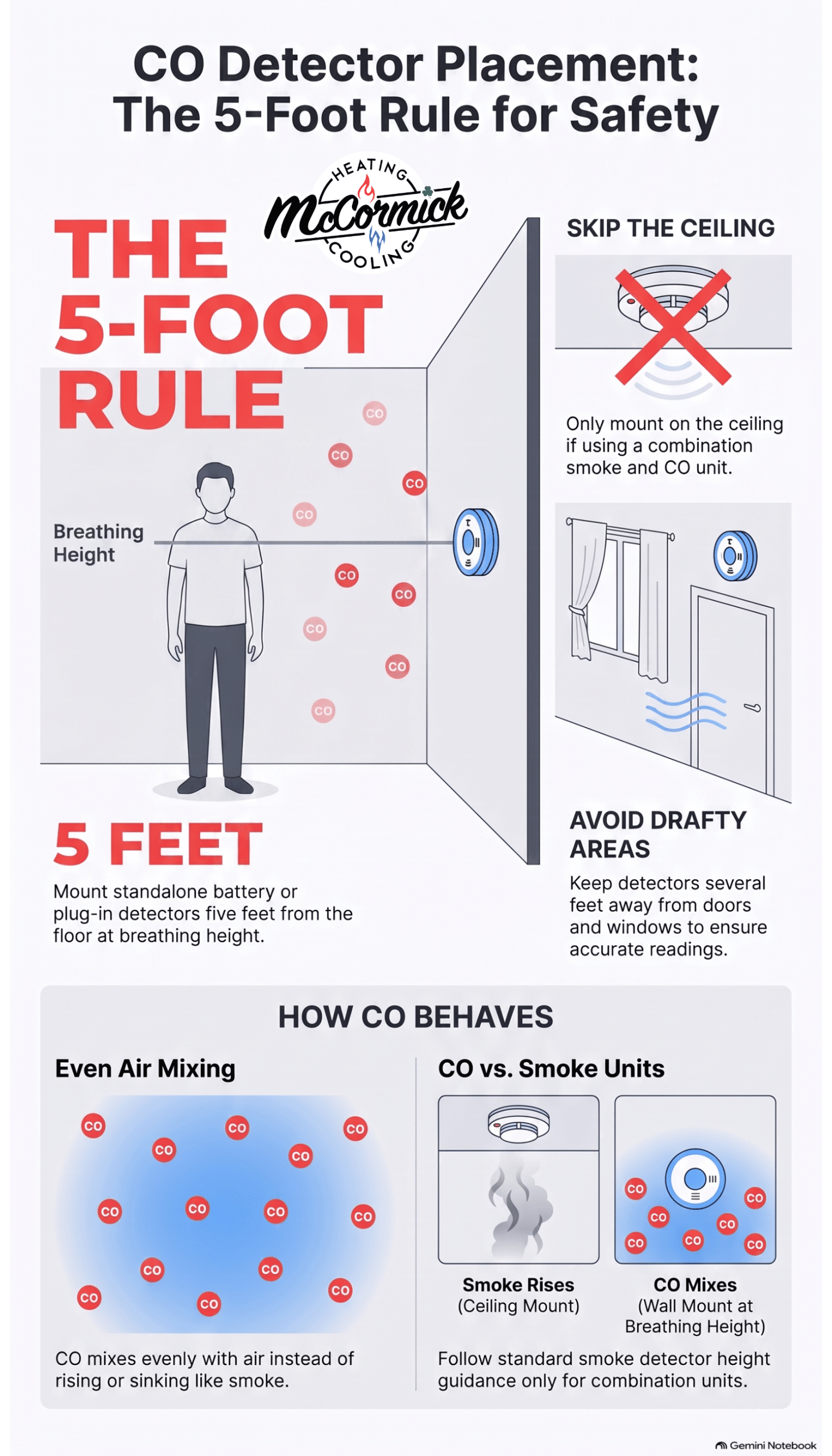
CO Detector Height: Where Should It Go on the Wall?
CO detector height depends on the type of unit, but most manufacturers recommend mounting battery- or plug-in detectors about five feet from the floor, roughly at breathing height for a seated or standing adult.
Carbon monoxide mixes evenly with air rather than rising or sinking the way smoke does, so ceiling placement isn’t necessary.
A few quick rules to follow:
- Mount standalone CO detectors around five feet high.
- Skip the ceiling unless you’re using a combination smoke and CO unit.
- Keep detectors a few feet from doors and windows to avoid drafts.
- Follow standard smoke detector height guidance for combo units instead.
CO Alarm Bedroom Placement: Protecting Sleeping Areas
CO alarm bedroom placement should always include a detector within earshot of every bedroom, even when bedrooms are on separate floors.
Colorado winters mean closed doors and furnaces running through the night, which is exactly when carbon monoxide exposure becomes most dangerous, because sleeping occupants cannot recognize early symptoms like headache or dizziness.
Hallway placement just outside bedroom doors is typically loud enough to wake a sleeping household.
Cracked Heat Exchanger Symptoms: The Hidden CO Source in Older Furnaces
Cracked heat exchanger symptoms are one of the most serious reasons Greeley homeowners need working CO detectors in the first place.
A cracked heat exchanger allows combustion gases, including carbon monoxide, to mix with the warm air your furnace blows into your living space instead of venting outside.
Watch for:
- A yellow or flickering pilot flame instead of a steady blue flame.
- Soot buildup around the furnace cabinet.
- A persistent odd smell whenever the system runs.
- A CO detector that alarms only while the furnace is cycling.
This kind of crack usually develops with age and isn’t something a homeowner can see without opening the cabinet. That’s why our furnace inspection includes a visual check of the heat exchanger for hot spots and cracks on every visit.
A furnace that’s quietly developing a cracked heat exchanger will not always announce itself with obvious symptoms.
If your furnace is more than 10 years old, or you can’t remember the last professional tune-up, call McCormick Heating & Cooling, and we’ll inspect the heat exchanger, burners, and venting as part of a full Heating Maintenance visit before another Greeley cold front rolls in.
What is the Right Number of CO Alarms for a Greeley House?
For adequate protection, install at least one device on each story of your home, as well as outside any bedroom doors. Coverage generally breaks down like this:
- Single-level home: two detectors, one central and one near bedrooms.
- Two-story home with basement: three to four detectors covering each level.
- Homes with an attached garage or fireplace: one additional detector near that source.
- Condos or townhomes near UNC: often just two units for full coverage.
If a CO detector ever sounds while your furnace is running, treat it as a true emergency. Get everyone outside immediately, call 911 or your gas utility from a safe location, and once the home is cleared, contact our Emergency HVAC Services team so a certified technician can find the source before the furnace runs again.
Key Takeaways
- CO detectors belong on every level of a Greeley home and outside every bedroom, not just near the furnace.
- Mount detectors about five feet high, since carbon monoxide mixes evenly with indoor air instead of rising.
- A cracked heat exchanger can leak carbon monoxide with no obvious signs, which is why annual furnace inspections matter.
- Most Greeley homes need two to four detectors placed correctly for full coverage.
Keeping Your Greeley Family Safe Through Another Colorado Winter
Correct carbon monoxide detector placement is a simple safeguard most homeowners can handle in an afternoon, but it only works alongside a furnace that’s actually inspected and maintained.
Older furnaces around Greeley’s established neighborhoods are exactly the units most likely to develop a cracked heat exchanger, ignition issue, or venting problem that a detector will eventually catch, but a professional inspection can catch first.
McCormick Heating & Cooling has served Northern Colorado homeowners for more than 20 years and earned over 1,000 five-star reviews, which you can see for yourself on our Google Business Profile.
Our NATE-certified technicians treat furnace safety with the same seriousness as comfort, because in a Greeley winter, both matter equally.
Don’t wait for an alarm to tell you something is wrong. Contact McCormick Heating & Cooling today to get your CO detectors placed correctly and your furnace checked by a local team that’s been doing this for two decades.

Frequently Asked Questions
Where should a carbon monoxide detector be placed in a home?
A carbon monoxide detector belongs on every level of a home, including the basement, and within ten feet of each bedroom door so the alarm is loud enough to wake sleeping occupants. This aligns with placement guidelines from the Environmental Protection Agency (EPA), which emphasizes the critical importance of hearing the alarm while asleep.
Additional detectors near fuel-burning appliances, attached garages, or fireplaces add extra protection in homes with more than one combustion source.
For a typical multi-level Greeley home, this usually means three or more detectors working together rather than a single unit near the thermostat.
Should a carbon monoxide detector be near the furnace?
Yes, placing a detector near the furnace room adds valuable early protection, though it should not be the only one in the home.
Manufacturers typically recommend keeping the unit at least 15 feet from the furnace and away from direct exhaust to avoid false alarms during normal startup cycles.
Pair that furnace-area detector with units near bedrooms and on other floors for complete coverage throughout a Greeley house.
How high on the wall should a CO detector go?
A CO detector should generally be mounted about five feet above the floor, near typical breathing height for an adult.
Because carbon monoxide mixes evenly with indoor air instead of rising like smoke, ceiling placement isn’t necessary and can sometimes reduce how quickly the sensor detects a leak.
Combination smoke and CO alarms are the exception and should follow standard smoke detector mounting height instead.
Can a cracked heat exchanger cause carbon monoxide?
Yes, a cracked heat exchanger is one of the most common ways carbon monoxide enters a home’s living space instead of venting safely outdoors.
As the metal ages and develops hairline cracks, combustion gases can mix with the warm air a furnace circulates through the ductwork.
Warning signs include soot near the furnace cabinet, a flickering or yellow pilot flame, and a CO detector that alarms specifically while the furnace is running.
How many carbon monoxide alarms should I install in my house?
As a general rule, you should place a minimum of one unit on every level of your residence and just outside all bedroom doors, meaning a standard single-family home with a basement will usually require between two and four devices.
Homes with an attached garage, fireplace, or multiple gas-burning appliances should add detectors near those extra combustion sources. Smaller condos or single-level homes may only require two detectors to achieve full protection.