






Emergency furnace repair becomes urgent the moment a dead furnace at 11 p.m. on a bitter-cold night stops being a maintenance inconvenience and turns into a safety event, especially once indoor temperatures start sliding toward freezing. If your furnace has quit producing heat, keeps cycling on and off without ever warming the house, or you smell gas or hear a carbon monoxide alarm sound off, you're not dealing with something that can wait for a weekday slot. That's the moment to call a licensed HVAC company immediately.
Below, we'll walk through exactly what qualifies as a true emergency in Loveland, how fast a technician can realistically show up at your door, and why our elevation combined with our wild day-to-night temperature swings makes a broken furnace a bigger risk here than it would be in a flatter, lower-altitude city. If you're facing any of these warning signs right now, don't wait it out. Contact McCormick Heating & Cooling for immediate emergency furnace repair before the temperature inside your home drops any further.
What Actually Counts as an Emergency Furnace Repair in Loveland?
Not every furnace hiccup requires a 2 a.m. phone call. The distinction comes down to whether the problem threatens safety or property, not just comfort.
Safety-Threatening Failures That Require Immediate Action
No heat during freezing outdoor temperatures is the most common true emergency. Loveland regularly sees overnight lows in the single digits or below zero between December and February, and a home without heat can drop into the 40s within six to eight hours, putting infants, older adults, and pets at real risk.
Other conditions that qualify as genuine emergencies:
- A gas odor or an active carbon monoxide alarm. Leave the home immediately and call 911 or your gas utility from outside first. Once the property is confirmed safe, call an HVAC technician to inspect the furnace's heat exchanger and ignition system.
- An electrical burning smell from the furnace cabinet or blower motor. This is a fire risk. Shut the system off at the thermostat or breaker before doing anything else.
- Active water leaking around a furnace or air handler, which can damage flooring, drywall, and the equipment's control board if left unaddressed overnight.
Furnace Problems That Can Wait for Regular Business Hours
A furnace that's a little noisier than usual, a slightly inaccurate thermostat, or a filter that needs changing are not emergencies. These issues are worth scheduling during standard weekday hours through a heating repair appointment, which gives the technician daylight, full parts availability, and time to diagnose thoroughly rather than triage.
How Fast Can a Technician Reach a No-Heat Call in Loveland?
McCormick Heating & Cooling has served Northern Colorado since 2004, and our technicians dispatch to Loveland from our Greeley headquarters at 2881 S 31st Ave #3 and our Platteville office on Main Street. Both locations sit within a short drive of Loveland's core neighborhoods, including Mariana Butte, Centerra, downtown Loveland along Cleveland Avenue, North Lake Park, and the streets bordering Boyd Lake State Park.
Because our team lives and works in Northern Colorado rather than dispatching from a distant call center, response time for a genuine no-heat emergency is measured in a small number of hours rather than a next-day window, particularly for calls placed after our 8 a.m. to 5 p.m. weekday hours.
A few factors affect exactly how quickly a technician arrives:
- Time of the call. A 7 p.m. call during a cold snap moves faster than one placed at 3 a.m. simply due to technician scheduling, though after-hours dispatch is available around the clock.
- Storm timing. During a widespread cold front across the Front Range, from Fort Collins down through Windsor and Longmont, call volume spikes and response windows can stretch slightly.
- Part availability. Our trucks stock common ignition modules, thermocouples, flame sensors, and blower capacitors, which resolves most no-heat calls on the first visit. A specialty part for an older or less common furnace model may require a short follow-up.
Why Loveland's Elevation and Winter Swings Make Furnace Failures More Dangerous
Loveland sits at roughly 4,982 feet in elevation, noticeably higher than Denver's 5,280 feet is often assumed to be, but still high enough that combustion physics change meaningfully compared to sea-level cities. Loveland sits at roughly 4,982 feet in elevation, noticeably higher than Denver's 5,280 feet is often assumed to be, but still high enough that combustion physics change meaningfully compared to sea-level cities. Gas furnaces rely on oxygen for proper combustion, and thinner air at altitude means a furnace that was sized or set up for a lower elevation can underperform start short-cycling before warming the house, or produce incomplete combustion, which raises the risk of carbon monoxide buildup if the heat exchanger has developed a crack.
This is why a furnace that "worked fine last year" can suddenly struggle once a component starts to wear. A furnace that's improperly derated for altitude works harder to reach set temperature, which shortens component life and increases the odds of a winter failure.
Northern Colorado's day-to-night temperature swings compound the problem. It is not unusual for Loveland to see a 50-degree afternoon followed by a below-freezing night within the same 24-hour window. That rapid swing forces a furnace's ignition system and blower motor to cycle harder and more frequently than equipment in a more climate-stable region, accelerating wear on aging igniters and heat exchangers, especially in furnaces already past the 15-year mark.
What to Do While You Wait for the Technician
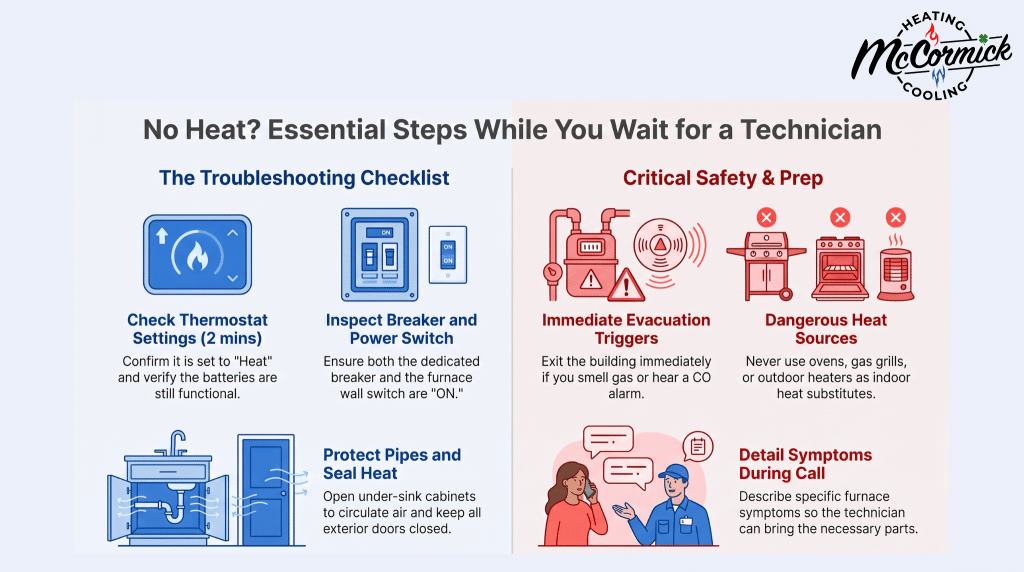
- Check the thermostat first (2 minutes). Confirm it's set to "Heat," the temperature is above room temperature, and batteries aren't dead if it's a battery-powered unit.
- Check the breaker and furnace switch (5 minutes). Furnaces have a dedicated breaker and often a wall switch near the unit that looks like a standard light switch. Both need to be in the "on" position.
- Open cabinet doors under sinks (ongoing). This lets warm air circulate around pipes and reduces the risk of a frozen or burst pipe while the furnace is down.
- Seal the house (ongoing). Keep exterior doors closed, draw blinds on north-facing windows overnight, and avoid opening the house up to cold air unnecessarily.
- Never use an oven, gas grill, or outdoor propane heater indoors as a substitute heat source. This creates a serious carbon monoxide risk in an enclosed space.
- Call ahead so a technician arrives with the likely parts already loaded based on your description of the symptoms.
Emergency Call vs. Standard Appointment: What's Different
Attribute |
After-Hours Emergency Call |
Standard Business-Hours Appointment |
Availability |
Nights, weekends, holidays
|
Monday to Friday, 8 a.m. to 5 p.m.
|
Typical response window |
Same-visit dispatch, hours not days
|
Scheduled slot, often next available day
|
Best suited for |
No heat in freezing temps, gas smell, CO alarm, burning smell, active leak
|
Noisy operation, minor inefficiency, scheduling an annual furnace tune up, or routine filter changes.
|
Technician preparation |
Triage-focused, common parts stocked on truck
|
Full diagnostic, more time for testing every component
|
How to request it |
Call directly for immediate dispatch
|
Submit an emergency service request or book online for a scheduled visit |
How to Vet an Emergency Furnace Repair Company Before They Arrive
Not every HVAC company that answers a late-night call is equipped to handle Colorado's altitude and climate demands correctly. A few things worth confirming before you approve any repair:
Certifications That Actually Matter
Look for NATE certification (North American Technician Excellence) and EPA certification, which confirm a technician has been tested on refrigerant handling, combustion safety, and diagnostic procedure rather than trained only on-the-job. McCormick's technicians carry both.
Three Questions to Ask Before Work Begins
- "What specifically failed, and how did you confirm it?" A technician should be able to point to a specific component, such as a failed flame sensor or a cracked heat exchanger, rather than a vague explanation.
- "Is this furnace properly sized and adjusted for our elevation?" This matters especially if the unit was installed by a company unfamiliar with Front Range altitude requirements.
- "What's the warranty on both the part and the labor?" A reputable local company backs after-hours work the same way it backs a full installation.
Local Example: A Mariana Butte Furnace Failure During a January Cold Snap
Consider a household near Mariana Butte Golf Course that woke up to their furnace not turning on during a stretch of single-digit overnight lows. The homeowners noticed the thermostat still called for heat, but the blower never kicked on. Following the steps above, they checked the breaker and switch first, found both fine, and sealed the home while waiting for a technician.
On arrival, the technician traced the issue to a failed hot-surface igniter, a common failure point on furnaces in that age range once they've logged more than a decade of Northern Colorado's long heating seasons. Because the part was already stocked on the truck, heat was restored the same visit, and the technician also flagged that the heat exchanger was showing early wear, giving the homeowners time to plan a replacement before the next cold snap rather than facing a second emergency call weeks later.
This is the pattern worth understanding: most emergency furnace calls trace back to one aging component, and catching it early prevents the failure from repeating.
Frequently Asked Questions
Don't Wait Out a Cold Night
A dead furnace during a Loveland cold snap isn't a problem you should troubleshoot alone until morning. When temperatures plummet, securing fast emergency furnace repair is vital to protect your home and family. Whether you live near Centerra, downtown Loveland, or out toward Boyd Lake, immediate professional intervention prevents a broken heater from turning into a costly frozen-pipe disaster.
Since 2004, McCormick Heating & Cooling has kept Northern Colorado families safe and warm through the harshest winters. Our local, NATE-certified technicians understand the unique stress our climate puts on high-altitude heating systems and arrive ready to restore your comfort. Don't spend the night shivering under blankets and hoping for the best. Call our live, after-hours dispatch team right now to get your heat running again. Let our family take care of yours tonight.