





Before You Call a Pro: The 15-Minute Fort Collins Furnace Fix

Furnace not turning on? In nearly every case, the cause is one of five things: a tripped switch, a dead thermostat battery, a lockout from repeated failed ignition attempts, a dirty flame sensor, or a frozen condensate line. Work through the checks below in the order they're listed. Most Fort Collins homeowners get their heat back within 15 minutes; a smaller number end up needing a technician that same night, and that's fine too.
McCormick Heating & Cooling has been called out for this exact issue across Fort Collins for two decades, from century-old homes near Old Town to newer construction along the Harmony Corridor. Below is the same diagnostic sequence our NATE-certified technicians use on service calls, laid out so you can try it yourself first.
Stuck after step one, or don't want to mess with the burner compartment yourself? Schedule a Fort Collins furnace diagnostic, and we'll have a technician confirm the exact cause before it turns into an overnight no-heat situation.
Why Is My Furnace Not Turning On At All?
Step 1: Check the Thermostat (30 seconds)
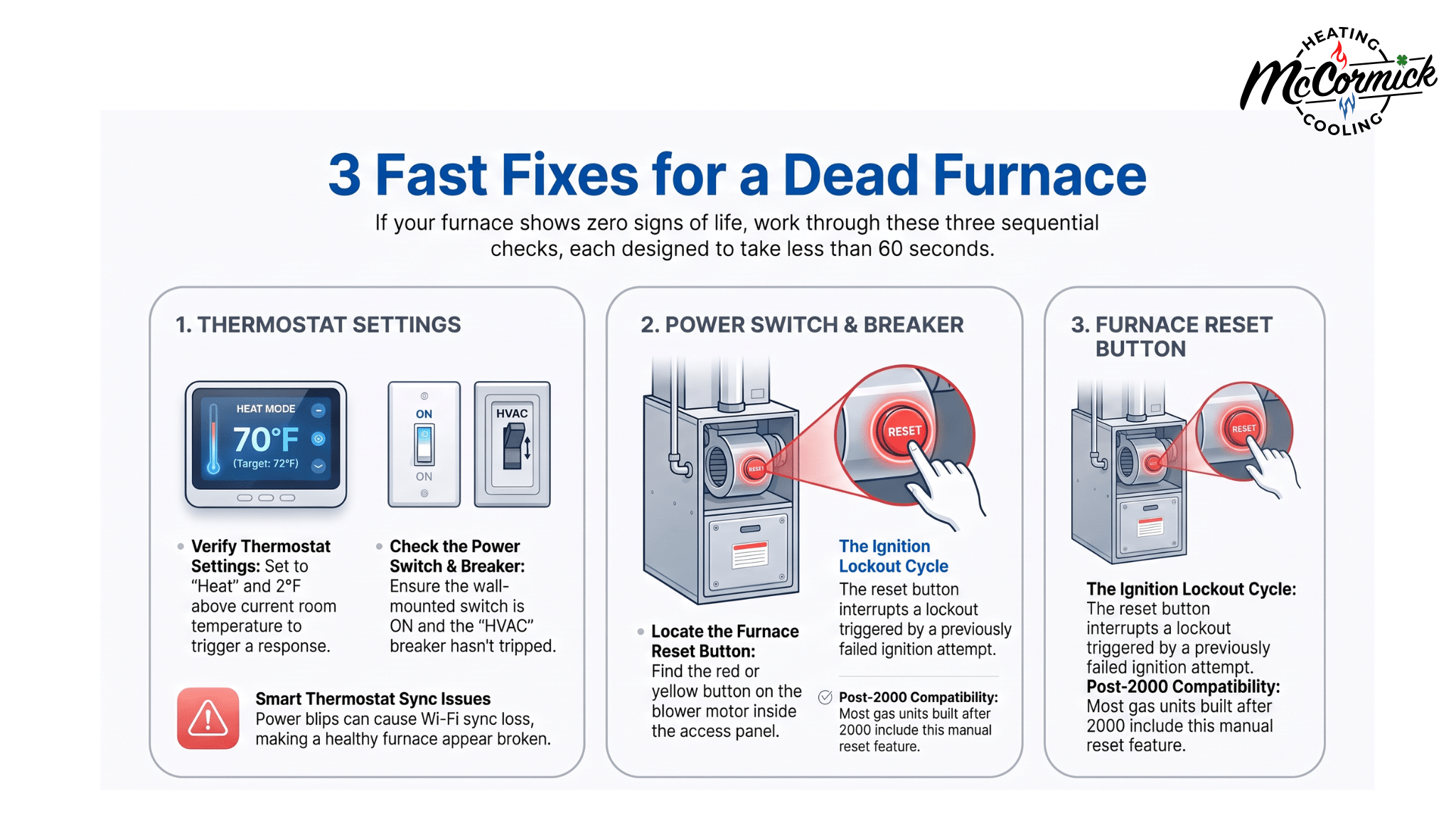
Confirm the thermostat display is lit and set to "Heat," with the target temperature at least 2 degrees above the current room temperature. Smart thermostats (Nest, Ecobee, Honeywell) occasionally lose Wi-Fi sync with the furnace's control board after a power blip, which reads to the homeowner as "the furnace won't turn on" even though the equipment itself is fine.
Step 2: Check the Power Switch & Breaker
Furnaces run on a dedicated 120V circuit, separate from the gas valve. Look for a wall-mounted switch near the furnace that resembles a standard light switch; it's easy to bump if the furnace closet doubles as storage. Then check your electrical panel for a tripped breaker labeled "Furnace" or "HVAC."
Step 3: Check the Furnace Reset Button
Most gas furnaces built after 2000 have a red or yellow reset button on the blower motor housing, typically inside the front access panel. This button interrupts a lockout cycle triggered by the control board detecting a failed ignition attempt.
Where Is My Furnace Reset Button, and How Do I Use It Safely?
Locating the Reset Button on Common Fort Collins Furnace Models
On Carrier, Trane, and Bryant units (the three brands showing up most in current Fort Collins search results), the reset button sits on the blower compartment door, near the motor housing. It's usually recessed slightly so it can't be triggered accidentally. Press it once, firmly, and hold for 3 to 5 seconds.
The "Two-Press Rule": When to Stop Resetting and Call a Pro
If pressing reset a second time doesn't restore heat, stop. A furnace that locks out twice in a row is telling you the underlying problem (ignitor, flame sensor, or gas valve) is still present, and repeated resets can force unburned gas into the heat exchanger. This is the point where DIY troubleshooting should end and a diagnostic call should begin, contact our heating repair team rather than continuing to cycle the reset.
Why Is My Furnace Not Responding to the Thermostat?
Dead Batteries, Miswiring & Smart Thermostat Conflicts
Most battery-powered thermostats display a low-battery icon, but some Honeywell models simply go blank. Replace the batteries first; it's the single fastest fix in this entire guide. If the display stays lit but the furnace still won't respond, the thermostat's call-for-heat signal isn't reaching the control board, which usually points to a wiring issue rather than a thermostat setting.
Control Board Communication Failures
The furnace's integrated control board reads the thermostat's signal and fires the ignition sequence. A control board with a failed relay will show power (the fan runs, the display lights up) but never initiate ignition. This is a component-level failure, not something to troubleshoot without a multimeter and furnace schematic.
Why Won't My Furnace Ignite? (Ignitor & Pilot Light Breakdown)
Cracked Hot Surface Ignitors: Lifespan & Failure Signs
Modern furnaces use a hot surface ignitor instead of a standing pilot light. Silicon nitride ignitors typically last 5 to 7 years; silicon carbide versions, common in older installs, often fail closer to the 3 to 4 year mark because they're more brittle under repeated heating and cooling cycles. A hairline crack in the ignitor element means it glows but never reaches the 2,000+ degree temperature needed to light the gas.
Pilot Light Won't Stay Lit: Thermocouple vs. Flame Sensor
If your furnace is older (pre-2000, common in some Old Town Fort Collins properties), it likely uses a standing pilot light and a thermocouple, a small copper rod that senses pilot flame heat and holds the gas valve open. A worn thermocouple loses its ability to generate enough millivoltage, so the gas valve closes and the pilot goes out repeatedly. Newer furnaces replace this with an electronic flame sensor, which does the same job electronically instead of thermally.
What Does a Dirty Flame Sensor Actually Do to a Furnace?
A flame sensor is a slim metal rod positioned directly in the burner flame. It confirms combustion is happening safely before the control board keeps the gas valve open. Over a heating season, this rod accumulates a thin layer of carbon and oxidation that insulates it electrically, even though it looks only slightly dirty to the eye.
The 3 Warning Signs of Flame Sensor Failure
- Furnace ignites, runs for 5 to 10 seconds, then shuts off (the sensor can't confirm flame due to the buildup, so the control board assumes no ignition occurred and cuts gas as a safety measure)
- Short-cycling that gets progressively worse over several days as carbon buildup increases
- A visible white, chalky, or black coating on the sensor rod when the burner compartment is opened
Cleaning vs. Replacement: Where DIY Should Stop
Light buildup can be removed with a fine emery cloth or steel wool, wiping the rod (not the wire) until bare metal shows. If cleaning doesn't resolve the furnace short-cycling within one heating cycle, the sensor itself may have degraded internally and needs replacement, which requires shutting off gas supply and testing resistance with a multimeter, a job best left to a licensed technician.
Is Fort Collins' Climate Making This Worse? (Local Proof Section)
5,003 Ft. Elevation and Combustion Air Starvation
Fort Collins sits at approximately 5,003 feet above sea level. At this elevation, ambient air contains roughly 15% less oxygen than at sea level, which means gas furnaces not properly derated for altitude burn less efficiently and stress ignition components faster. A furnace installed without altitude adjustment may show intermittent ignition failure that a sea-level troubleshooting guide won't catch.
Chinook Wind Swings Near Horsetooth & the Foothills
Neighborhoods along the Foothills and near Horsetooth Reservoir experience Chinook wind events where outdoor temperatures can swing 30+ degrees within a few hours. These rapid pressure changes can cause backdrafting in older atmospheric-vent furnaces, momentarily pushing exhaust gases back down the flue and triggering a safety lockout that mimics an ignition failure.
Frozen Condensate Lines in Older Old Town & CSU-Area Homes
High-efficiency condensing furnaces (90%+ AFUE) produce condensate that drains through a PVC line, often routed to an exterior wall in older Old Town and CSU-area rental properties. During a sustained cold snap, that line freezes, the condensate backs up, and a float switch shuts the furnace down completely. This looks identical to an ignition failure but has nothing to do with the ignitor or flame sensor at all.
DIY Furnace Troubleshooting Checklist
- Check thermostat settings and batteries (2 minutes)
- Check the furnace power switch and breaker (2 minutes)
- Press the reset button once (1 minute, wait 5 minutes before judging results)
- Inspect the furnace filter for restricted airflow that can trigger overheating shutoffs (5 minutes)
- If it locks out a second time, stop resetting and inspect the flame sensor visually if you're comfortable opening the burner compartment (10 minutes)
- If condensate lines are visible and frozen, do not attempt to thaw them with an open flame; call for professional service
Local example: A homeowner near City Park in Fort Collins had a furnace shut off twice overnight during a January cold snap. The thermostat and breaker checked out fine. On inspection, the flame sensor showed heavy carbon buildup from a full season without a tune-up. A quick cleaning resolved the short-cycling immediately, but the underlying cause (a missed fall maintenance visit) meant the same failure was likely to repeat the following winter without a comprehensive furnace tune up.
When "Furnace Won't Start" Becomes a Safety Emergency
Stop troubleshooting immediately and leave the house if you smell rotten eggs (added gas odorant), hear a hissing sound near the gas line, or your carbon monoxide detector activates. Because carbon monoxide is an odorless, colorless gas, the Centers for Disease Control and Prevention (CDC) advises immediate evacuation if an alarm sounds. These are not furnace mechanical issues; they are severe combustion safety emergencies that require an immediate professional response.
For a genuine no-heat situation outside business hours, especially during a hard freeze, contact our emergency HVAC services team directly rather than waiting until morning.
DIY Fix vs. Calling a Fort Collins Technician
Symptom |
Time to Diagnose |
Tools Needed |
Risk Level if Handled Incorrectly |
Recommended Action |
Thermostat blank or unresponsive
|
Under 5 minutes
|
None (battery swap)
|
Low
|
Safe to DIY
|
Tripped breaker or power switch off
|
Under 5 minutes
|
None
|
Low
|
Safe to DIY
|
Furnace locks out once, resets fine
|
10 minutes
|
None
|
Low
|
Safe to DIY, monitor for recurrence
|
Furnace locks out a second time
|
N/A
|
Multimeter, furnace manual
|
Medium
|
Call a technician
|
Visible cracked ignitor
|
15 minutes to inspect
|
Flashlight
|
Medium (glass/ceramic component)
|
Call a technician for replacement
|
Dirty flame sensor, mild short-cycling
|
15 minutes
|
Emery cloth, screwdriver
|
Medium (gas valve nearby)
|
DIY cleaning possible, replacement needs a pro
|
Frozen condensate line
|
N/A
|
None safe for DIY
|
High (float switch, PVC damage)
|
Call a technician
|
Gas smell or CO alarm
|
Immediate
|
None, evacuate
|
Severe
|
Leave home, call emergency service
|
When troubleshooting hits a wall or poses a safety risk, do not leave your home's comfort to chance. Reach out to Northern Colorado's trusted Greeley furnace company, McCormick Heating & Cooling, to have a NATE-certified technician safely restore your heat today.
Frequently Asked Questions
Get It Fixed Right: Schedule Fort Collins Heating Repair
If you have worked through the troubleshooting checklist above and are still dealing with a furnace not turning on, do not keep pressing the reset button. Repeated lockouts are your control board's way of signaling a specific component failure, and forcing the system to cycle only increases wear on your ignitor and gas valve.
Since 2004, McCormick Heating & Cooling has dispatched NATE-certified technicians from our Greeley headquarters to resolve these exact issues across Fort Collins, Loveland, Windsor, and Wellington. We arrive equipped with the advanced diagnostic tools including multimeters, manometers, and combustion analyzers needed to pinpoint the root cause of your heating failure, a commitment to accuracy backed by over 1,104 verified 4.9-star Google reviews.
Waking up to a cold house is stressful enough without having to guess how to fix your equipment. Let our local team take it from here. Check our full service areas list to see if a technician is nearby, or reach out to schedule a diagnostic visit.