
Furnace Short Cycling: Causes & Fixes | Loveland, CO
If your furnace has been turning on, running for a few minutes, then shutting off before your house actually warms up, you’re dealing with furnace short cycling. In Loveland, where overnight temperatures regularly drop below freezing from October through April, a furnace that can’t complete a full heating cycle isn’t just annoying.
It’s a sign something in the system is struggling, and it tends to get worse right when you need heat most.
Furnace short cycling usually points to one of a handful of specific problems: a clogged filter, a failing flame sensor, an oversized system, or a safety switch doing exactly what it’s designed to do. The fix depends entirely on which one is happening in your home.
What Furnace Short Cycling Sounds Like Before It Becomes a Bigger Problem
Short cycling has a pattern. The furnace fires up, runs for two to five minutes, shuts off, sits quiet for a short stretch, then starts again.
Repeat that all evening and your thermostat never quite reaches the temperature you set.
Homeowners often describe it as the furnace turning on and off repeatedly without ever “catching up.”
That pattern puts extra wear on the ignition system and blower motor with every cycle, since starting a furnace puts more strain on its components than running steadily.
Why Does My Furnace Keep Turning On and Off?
When a furnace repeatedly starts and stops without finishing a normal heating cycle, it is usually because an airflow restriction or safety switch forces an early shutdown.
The most common culprits are blocked airflow, a coated flame sensor, or faulty signals from your thermostat.
A few specific culprits show up again and again on service calls:
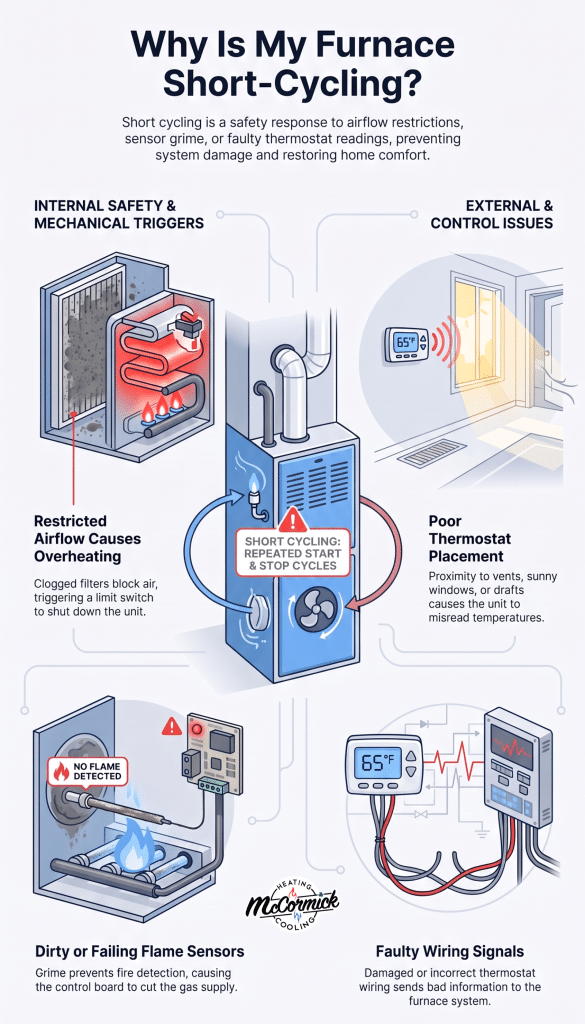
- Restricted airflow. A furnace pulls air across its heat exchanger to stay within a safe temperature range. When that airflow is blocked, the unit overheats and a limit switch shuts it down as a protective measure. This is clogged filter short cycling, and it’s one of the easiest fixes on this list.
- A dirty or failing flame sensor. This sensor detects an active burner. If it becomes covered in grime or begins to fail, it won’t register the fire, prompting the main control board to shut off the gas supply as a safety precaution. This is flame sensor short cycling, and it typically requires a technician to clean or replace the sensor.
- Thermostat placement or wiring issues. A thermostat mounted near a heat vent, a sunny window, or a drafty hallway can misread the room and cycle the furnace based on bad information.
If any of this sounds like what’s happening in your home, McCormick Heating & Cooling can pinpoint the exact cause during one visit. Our Heating Repair technicians show you the failed component before any repairs, so you’re never guessing what you’re paying for.
Is Short Cycling Bad for a Furnace?
Yes, short cycling is bad for a furnace because furnaces are built to run in steady stretches, not in constant bursts.
When a furnace short-cycles dozens of times a day over a full winter, it wears out far faster than one that runs normally.
Here is what happens when short cycling is left unaddressed:
- Increased mechanical stress: Each restart puts more strain on the ignition system, blower motor, and electrical components than a normal, complete heating cycle does.
- Premature part failure: Ignitors fail sooner, and blower motors overheat more often.
- Higher energy bills: The system works much harder and draws more power to produce less consistent heat.
- Escalating repair costs: A minor airflow issue today can turn into a completely failed ignitor or motor by January.
Furnace Cycling Too Often in Loveland, CO Homes This Winter
Loveland’s mix of older homes near downtown and newer construction closer to Centerra creates two very different short cycling stories. Older homes often have aging ductwork or furnaces working past their prime, leading to airflow restrictions and worn components.
Newer, tightly insulated homes sometimes have the opposite problem: an oversized furnace short cycling because it was sized for an older, leakier version of the house and now heats the space too fast, satisfies the thermostat in minutes, then shuts off before a full cycle completes.
Either way, furnace cycling too often during a Front Range cold snap means your system is fighting itself instead of your house.
McCormick has serviced furnaces across Loveland’s older neighborhoods and newer developments alike. If your no-heat or short-cycling problem turns into an urgent situation after hours, our Emergency HVAC Services team is available around the clock.
How McCormick Diagnoses a Short-Cycling Furnace
A short-cycling diagnosis starts with watching a full heat cycle, not just listening to the symptom.
NATE- and EPA-certified technicians check the thermostat signal, inspect the filter and airflow, test the flame sensor, and inspect the heat exchanger for cracks, since a cracked exchanger can also trigger safety shutdowns.
McCormick has served Northern Colorado homeowners for more than 20 years and holds a BBB A+ accreditation with over 1,030+ five-star Google reviews. You can see recent feedback and confirm service details on our Google Business Profile.
How Do I Stop My Furnace from Short Cycling?
You can stop furnace short cycling with a few basic checks before calling a professional to diagnose mechanical or electrical issues.
- Replace a dirty filter: A dust-clogged filter restricts airflow immediately. Changing it every 30 to 90 days is the first and easiest step.
- Change the thermostat batteries: A dying battery can often send erratic cycling signals to the furnace, making this a safe, quick DIY fix before calling a technician.
- Keep vents unblocked: Ensure your household vents are open and clear of furniture or rugs to maintain proper airflow.
- Schedule a professional inspection: If the short cycling continues after a filter swap and new batteries, the cause is likely a flame sensor, a limit switch, or a sizing mismatch, and that calls for a technician rather than a guess.
Our Furnaces page covers maintenance plans that catch these issues before they turn into a no-heat call.
Key Takeaways
- Furnace short cycling almost always traces back to airflow, a flame sensor fault, or a sizing mismatch.
- Left unaddressed, short cycling accelerates wear on the ignitor and blower motor.
- Loveland’s mix of older and newer homes creates different short cycling causes worth ruling out separately.
- A filter change solves some cases; a professional diagnosis is needed for the rest.
Your Furnace Is Telling You Something. Listen Before January.
A furnace that keeps turning on and off is rarely a coincidence and rarely fixes itself. The earlier a Loveland homeowner catches the pattern, whether it’s a clogged filter, a worn flame sensor, or a heating system with improper capacity for your home’s square footage, the smaller and less expensive the repair tends to be.
In fact, the ENERGY STAR® Heating and Cooling Maintenance Checklist highlights how critical it is to address these early warning signs and schedule seasonal tune-ups to extend your system’s lifespan.
Waiting until the coldest week of winter means competing with every other struggling furnace in the county for the same appointment slots.
McCormick Heating & Cooling has diagnosed short-cycling furnaces across Loveland and Northern Colorado for more than two decades. Contact McCormick Heating & Cooling to get a technician out before the next cold front settles in.

Frequently Asked Questions
Why does my furnace keep turning on and off?
Your furnace keeps turning on and off because a safety switch is shutting it down before a full heating cycle completes, usually caused by restricted airflow from a dirty filter, a failing flame sensor, or a thermostat that isn’t reading the room correctly. Each of these triggers a protective shutdown rather than letting the furnace run in an unsafe condition.
Is short cycling bad for a furnace?
Yes, short cycling is bad for a furnace because frequent restarts place more strain on the ignition system and blower motor than continuous operation, accelerating wear on both. Over a winter season, this added stress often leads to component failures that could have been prevented with an earlier diagnosis.
Can a dirty air filter cause short cycling?
Yes, a clogged filter often triggers short cycling by blocking proper airflow over the heat exchanger, causing the furnace to overheat and shut down through its built-in limit switch. Replacing the filter is often the fastest and most affordable fix for this specific cause.
How do I stop my furnace from short cycling?
You can stop furnace short cycling by first replacing the air filter and checking that vents aren’t blocked, since airflow restriction is the most common cause. If the pattern continues afterward, a professional inspection of the flame sensor, limit switch, and furnace sizing is the next step to find and correct the underlying issue.