
5-Star Reviews
Years of Local Service
Accredited Business
Technicians
and Operated
If your house smells like campfire every August, and the dust never stops, McCormick can help. At 4,665 feet, Greeley experiences persistent dust and Front Range wildfire smoke from July through September. McCormick installs high-efficiency filtration as part of its indoor air quality services and tests your HVAC system before recommending a filter rating.
What Is Whole-Home High-Efficiency Filtration (and What Does MERV Mean)?
Whole-home high-efficiency filtration uses a deep media air cleaner installed in the HVAC return to capture particles before conditioned air circulates through the home. Its MERV rating indicates which particle sizes the filter can capture under standardized testing conditions.
A media air cleaner replaces or supplements the narrow filter slot found on many forced-air systems. Its cabinet holds a pleated filter that is typically 4 to 5 inches deep, providing substantially more filtering surface than a standard 1-inch filter.
That added surface area matters because filtration and airflow must remain balanced. A dense 1-inch filter can create excessive resistance in a system that was not designed for it. A correctly sized media cabinet spreads airflow across a larger surface, allowing higher-efficiency filtration with less resistance.
MERV stands for Minimum Efficiency Reporting Value. In practical terms:
- MERV 8 captures common household dust, lint, and larger particles.
- MERV 11 provides improved capture of pollen, pet dander, and smaller dust particles.
- MERV 13 captures finer particles, including many particles associated with wildfire smoke.
- MERV 16 provides even finer filtration but must be matched carefully to the HVAC system's airflow capacity.
A higher number is not automatically better for every furnace or air handler. The correct rating is the highest level the system can use while maintaining proper airflow and acceptable static pressure.
For a deeper comparison of filter ratings and technologies, read McCormick's guide to MERV and HEPA filtration.
High-efficiency filtration captures particles, but it does not treat biological growth on an HVAC coil or control winter dryness. Those concerns may require an HVAC UV light or a whole-home humidifier.
What Are the Signs a Greeley Home Needs Better Filtration?
Whole-home filtration may need improvement when dust returns shortly after cleaning, smoke particles enter during Front Range wildfire season, filters darken unusually quickly, or a dense 1-inch filter causes airflow problems. The HVAC system should be tested before increasing its MERV rating.
Signs that warrant a filtration and airflow assessment include:
- Dust returns within days of cleaning. The existing filter may capture larger debris while allowing finer particles to continue circulating through the HVAC system.
- Wildfire smoke enters during July through September. A lower-rated filter may not capture enough of the fine particulate matter carried indoors during Front Range smoke events.
- The filter turns gray within several weeks. Rapid loading can indicate elevated particle levels, an undersized filter, or a filter that needs a different replacement interval.
- Indoor irritation increases when the system operates. Particle recirculation may be contributing, although HVAC filtration is not medical treatment and cannot address every possible source.
- The furnace begins tripping its limit after a filter upgrade. A dense 1-inch filter can restrict airflow, allowing heat to build inside the furnace.
- The AC coil begins icing after a filter change. Restricted airflow across the indoor coil can cause its temperature to fall below the intended operating range.

Simply installing the highest-rated filter available can create a new HVAC problem. McCormick measures airflow and static pressure to determine whether the existing filter is passing too many particles, restricting the system, or both.
Filter condition also varies with occupancy, pets, home projects, equipment use, and outdoor air. Learn how often an HVAC filter should be changed in Northern Colorado and review the Greeley wildfire-smoke home air defense guide for broader smoke-season preparation.
How McCormick Makes a Filtration Upgrade Simple
High-efficiency filtration installation begins with testing rather than selecting a filter by its label alone. McCormick follows the same three-step plan across its residential HVAC services:
- Call (720) 217-4801 or request service online. Tell us what you're seeing - no diagnosis needed.
- A NATE-certified McCormick technician arrives, tests the system, and shows you the findings before any work is approved.
- You approve the fix, we complete it, and you get the documentation your warranty requires.
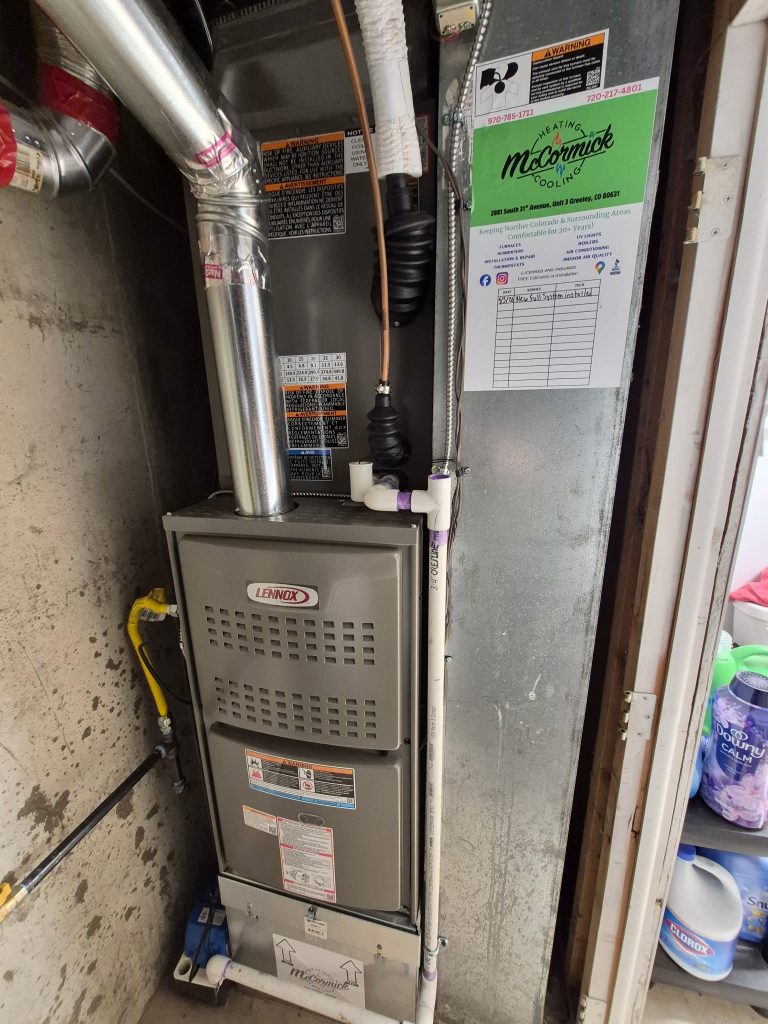
How McCormick Installs a Whole-Home Media Air Cleaner
Whole-home media air cleaner installation focuses on the physical cabinet, return-air configuration, filter fit, and final airflow performance.
The technician first measures static pressure across the existing filter and evaluates the system's airflow. These readings show how much resistance the current filter creates and help determine which filtration level the equipment can support.
The technician then:
- Inspects the existing return-air configuration
- Identifies an accessible location for the media cabinet
- Sizes the cabinet to the available return and HVAC equipment
- Removes or modifies the existing filter slot when required
- Fits the media cabinet into the return-air path
- Seals cabinet connections to limit air bypass
- Installs a filter with an appropriate MERV rating
- Tests static pressure and system operation after installation
- Confirms that the cabinet door closes and seals correctly
Cabinet sealing is important because unfiltered air can bypass a poorly fitted filter through gaps around the housing. Air bypass reduces particle capture even when the filter itself carries a high MERV rating.
Final testing confirms whether the installed filter maintains acceptable airflow in heating and cooling modes. If the pressure reading is too high, the technician can reassess the filter rating, cabinet configuration, or another source of airflow resistance.
What Does a Filtration Upgrade Visit From McCormick Include?
A filtration upgrade visit includes an airflow assessment, documented findings, a system-compatible filter recommendation, clear performance expectations, and a replacement schedule. Homeowners receive the information needed to select, monitor, and maintain the installed media filter after the physical installation is complete.
The visit includes:
- An explanation of the original filter condition: The technician reviews whether the existing filter was passing fine particles, loading quickly, restricting airflow, or showing another concern.
- Static-pressure findings: Homeowners learn how the existing and upgraded filters affect resistance in the return-air path.
- A system-compatible MERV recommendation: McCormick explains why the selected rating fits the furnace or air handler rather than recommending a higher number automatically.
- Filter identification: The homeowner receives the correct media size and rating needed for future HVAC air filter replacement.
- Realistic performance expectations: The technician explains which particles the filter is designed to capture and which indoor air concerns require another solution.
- A replacement schedule: The recommended inspection and replacement interval is based on filter depth, household conditions, equipment use, and seasonal smoke exposure.
- Filter-check guidance: Homeowners learn how to inspect the media without damaging the cabinet or installing the replacement backward.
- Ongoing maintenance guidance: The filter can be checked during visits included in McCormick's preventative maintenance plan.
A 4- to 5-inch media filter commonly remains in service longer than a 1-inch filter because it contains more filtering surface. Replacement may be needed sooner during wildfire-smoke periods, in homes with pets, or when indoor particle levels are elevated.
How Long Does a Media Air Cleaner Installation Take?
Media air cleaner installation is generally completed during one service visit. The required time depends on return-air access, cabinet dimensions, existing filter placement, available working space, sealing requirements, and whether the current HVAC configuration needs adjustment to fit the new cabinet properly.
A straightforward installation beside an accessible furnace may take less time than one involving a tight mechanical area or a return configuration with limited cabinet space. McCormick assesses these conditions before beginning the approved work.
Media Air Cleaner vs. 1-Inch MERV 13 Filter - Which Is Right for an Older Greeley Furnace?
A media air cleaner is often better for an older furnace because its deeper filter provides more surface area for airflow. A 1-inch MERV 13 filter may create excessive static pressure unless testing confirms that the existing system can operate with the added resistance.
Both filters may carry the same MERV rating, but they do not necessarily place the same demand on the blower. Filter depth and total surface area affect how easily air can pass through the media.
A 4- to 5-inch filter typically provides several advantages:
- More surface area for capturing particles
- Lower resistance than a dense 1-inch filter with similar efficiency
- Greater particle-holding capacity
- A longer interval between replacements under typical conditions
- Less rapid loading during periods of elevated dust or smoke
A 1-inch MERV 13 filter can work in a system designed and tested for it. However, placing one in an older furnace that previously used a less restrictive filter can reduce airflow. During heating, inadequate airflow can contribute to high-temperature limit trips. During cooling, it can contribute to coil icing.
A media cabinet is not selected by furnace age alone. McCormick measures static pressure, checks blower operation, and evaluates the return-air path before determining which filter format and MERV rating the system can support.
A portable HEPA unit may supplement filtration in one room, but it does not filter all the air moving through the home's central HVAC return.

Why Choose McCormick for Filtration Upgrades in Greeley?
McCormick Heating & Cooling is based at 2881 S 31st Ave, Unit 3, in Greeley. McCormick is insured, and its technicians are NATE- and EPA-certified. The company has maintained BBB A+ Accreditation since 2015 and has received more than 800 Google reviews.
The same HVAC team that installs the cabinet can inspect the filter, evaluate airflow, and identify developing equipment concerns during future maintenance. McCormick also explains when a filtration upgrade is appropriate and when an indoor air concern requires a different solution.
High-Efficiency Filtration Installation Across Northern Colorado
High-efficiency filtration installation is dispatched from McCormick's Greeley headquarters at 2881 S 31st Ave, Unit 3. McCormick installs and maintains residential media air cleaners in Greeley and nearby communities across Weld, Larimer, and Boulder counties.
The service area includes:
High-Efficiency Filtration FAQs
People Also Ask
Prepare Your Greeley Home for Dust and Smoke
Dust circulates throughout the year, and Front Range smoke can place an additional particle load on a Greeley home from July through September. A properly sized media air cleaner helps capture those particles without relying on a dense filter the system may not support.
McCormick can test your current filter's resistance, assess the return-air configuration, and recommend a filtration level matched to the HVAC equipment.