
Colorado Hail Season Starts Now: Why Your AC Insurance Claim Has a Hidden Deadline Most Greeley Homeowners Miss
Greeley and Northern Colorado sit directly inside one of the nation’s most active hail corridors. Recently, Weld County recorded severe early spring hailstorms, earlier than most homeowners along the I-25 and US-34 corridors anticipated.
When that hail hits your outdoor AC unit, the damage isn’t always visible from the driveway. But the financial hit is very real.
A hail damage AC insurance claim Colorado may help cover eligible repairs or replacement, depending on the severity of the damage, the system’s condition, and the terms of the homeowner’s policy.
The problem? Most Greeley homeowners never see a dime because they wait too long to call a professional.
Don’t absorb the cost of a full system replacement. If your neighborhood was hit by hail, your next step is securing a professional damage assessment.
Need an insurance-ready AC inspection now?
McCormick Heating & Cooling provides the exact written documentation adjusters require. Call for Fast Local Service.
Why Greeley’s Geography Puts Your AC at Risk Every Spring
Weld County averages 8 to 12 significant localized hail events per year, with peak risk running from May through September.
The open flatlands stretching between Greeley and Evans give storms almost no terrain to slow down before they tear through residential neighborhoods.
Your AC condenser sits fully outdoors with zero protection. Quarter-sized hail traveling at 25 mph can easily bend aluminum condenser fins and crack coil housings.
This damage won’t necessarily stop your AC from turning on today, but it will quietly destroy your system’s efficiency and compressor long before August. This is exactly why filing a hail damage AC insurance claim Colorado is highly time-sensitive.
The longer AC condenser damage goes uninspected, the harder it becomes to separate storm impact from general wear-and-tear. Experienced adjusters look for this delay to deny your payout.
What Hail Actually Does to Your AC Condenser
Air conditioner storm claims are frequently denied because homeowners rely on a quick visual check instead of a professional diagnostic.
If you suspect storm damage, look for these immediate warning signs:
- Bent, flattened, or crushed condenser fins on the outdoor housing
- Dents on the metal cabinet or visible damage along refrigerant lines
- Reduced cooling performance or warm air from supply vents
- New rattling, buzzing, or grinding sounds from the outdoor unit
- Ice formation on coils or unexplained refrigerant leaks
If your unit is showing any of these signs, don’t wait. McCormick’s AC repair team provides written damage assessments that are formatted exactly the way insurance adjusters need to process your claim.
Don’t File Without This First
A verbal “it looks damaged” won’t win your insurance claim. McCormick’s NATE-certified technicians document AC condenser hail damage in writing, the exact evidence your insurer requires.
The Hidden Deadline That Kills Most Claims
Colorado law gives property owners up to two years from the storm date to file a hail damage AC insurance claim Colorado. But that two-year window is a legal backstop, not your insurance company’s timeline.
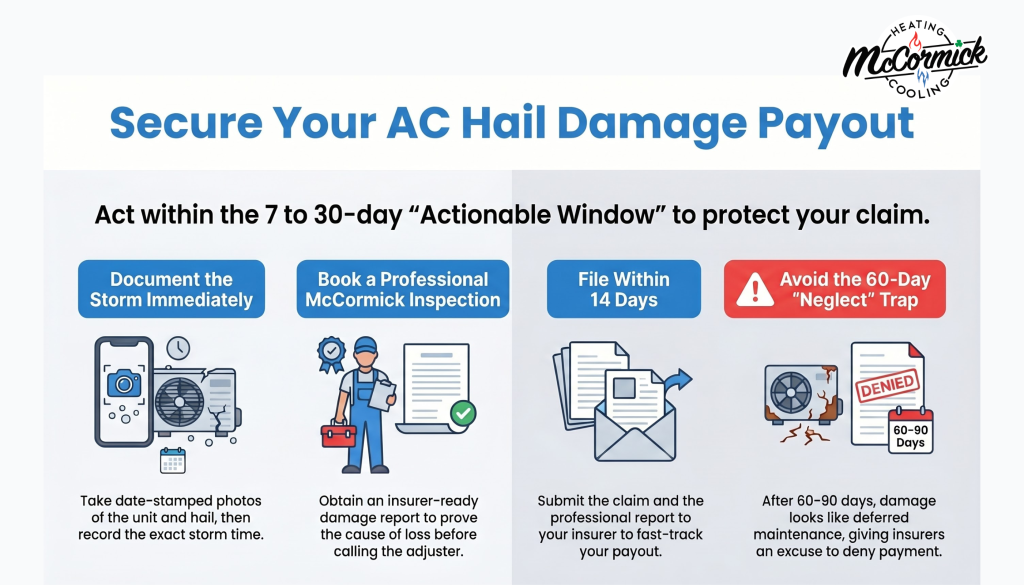
Here is the real risk: AC condenser damage left uninspected for 60 to 90 days begins to look like deferred maintenance in an adjuster’s report.
The actionable window is 7 to 30 days from the storm event. McCormick’s 24-hour emergency HVAC services include post-storm assessments for Greeley, Fort Collins, Loveland, Windsor, and Longmont, with written reports ready for insurer submission.
How to Fast-Track Your AC Hail Damage Claim
A successful insurance payout comes down to professional documentation before you call the adjuster.
Follow this exact sequence to protect your claim:
1. Photograph the Unit
Take date- and time-stamped photos of the AC unit and any hail accumulation on your property immediately after the storm.
2. Pull Weather Data
Note the exact time and date of the storm for your insurance form.
3. Book a Professional HVAC Inspection
This is the most critical step. Have McCormick Heating & Cooling inspect the unit and generate an insurer-ready damage report.
4. File the Claim
Notify your insurer within 7 to 14 days of the event, submitting McCormick’s written report alongside your claim.
Act This Week, Not This Season
A property claim is straightforward, but it is unforgiving when delayed.
Greeley homeowners who recover full reimbursement for their AC units are the ones who call an HVAC technician the week of the storm.
A fast, professional inspection today is the only way to avoid paying for a full system replacement out-of-pocket later this summer.
McCormick Heating & Cooling, Greeley’s Trusted HVAC Experts
5-Star Google Rated | Locally Owned & Operated | NATE & EPA Certified
Request a Free Estimate or Book an Inspection with McCormick Heating & Cooling Now.
Serving Greeley, Fort Collins, Loveland, Windsor, Longmont, Platteville, and all of Northern Colorado

Frequently Asked Questions
Does homeowners insurance cover hail damage to an air conditioner in Colorado?
Yes.
Standard Colorado homeowners policies typically covers sudden, storm-caused AC hail damage verified by a licensed professional. However, higher wind/hail deductibles are increasingly common in Weld County. Check your policy’s declarations page to confirm your specific coverage limits.
How long do I have to file a hail damage insurance claim in Colorado?
Colorado law allows two years, but insurers expect notification within 30 days.
Late claims are often denied and reclassified as deferred maintenance, eliminating your payout. Always call a professional HVAC technician immediately after a storm to protect your claim.
How do I know if my AC was damaged by hail?
Beyond obvious dents, the best confirmation is a licensed HVAC inspection.
Hidden performance issues, like efficiency drops, inconsistent cooling, or refrigerant leaks, often surface weeks later. A professional post-storm assessment is far more reliable than a simple visual check.