
Musty Smell When the AC Runs? What That Odor Is Telling You About the Air in Your House
Greeley sits at roughly 4,665 feet on Colorado’s dry Front Range, where summer humidity barely cracks 30% even on the muggiest July afternoon.
That’s exactly why so many homeowners get confused when their AC smells musty the second the system kicks on; dry outdoor air shouldn’t smell like a damp basement.
If your AC smells musty every time the compressor starts, you’re smelling trapped moisture and biological growth inside the equipment itself, not the climate outside your windows.
The fix ranges from a simple filter swap to a full coil cleaning, and in stubborn cases, a UV light install.
Before spending money guessing, it helps to know why an AC smells musty in the first place and what that smell is telling you about the air moving through your house right now.
Why Your AC Smells Musty the Second It Turns On
When an AC smells musty right at startup, the odor is almost always tied to standing moisture somewhere in the system. Colorado’s dry outside air doesn’t cause this; trapped condensation inside the unit does.
That’s the real answer to why my house smells when the AC turns on: moisture, not dust, is the root problem.
Common triggers include:
- Condensation sitting on the evaporator coil overnight
- A clogged or slow-draining condensate line
- Dust-caked filters holding moisture near the coil
- Ductwork that never fully dries between cooling cycles
This is why an AC smell after being off for several hours often hits harder than when the system runs continuously; stagnant moisture has more time to grow odor-causing bacteria before the blower disturbs it again.
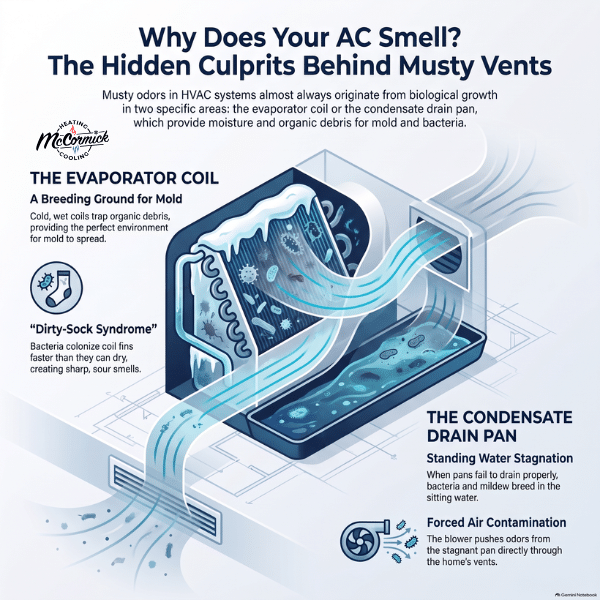
What’s Actually Growing Inside Your Ductwork and Coil
Musty air from vents usually traces back to one of two sources: the evaporator coil or the drain pan sitting beneath it.
Mold in the evaporator coil thrives because the coil stays cold and wet during every single cooling cycle. Dust and organic debris stick to that moisture, creating the exact environment mold needs to spread.
A dirty-sock-syndrome HVAC situation: the sharp, sour, gym-locker smell technicians hear about constantly happens when bacteria colonize the coil’s fins faster than they can dry between cycles.
The condensate drain pan smell is the second culprit. If the pan doesn’t drain properly, standing water sits for days, breeding bacteria and mildew that get pushed straight through your vents every time the blower turns on.
Noticing musty air every time your AC cycles? Request a Free Estimate and a McCormick technician can inspect your coil and drain line this week before the smell gets worse.
Is a Musty AC Smell Actually Dangerous?
For most healthy adults, a musty AC smell situation is unpleasant rather than hazardous.
But mold spores and bacterial growth inside ductwork can trigger real symptoms for anyone with asthma, allergies, or a weaker immune system.
Watch for:
- Sneezing or congestion that starts when the AC runs
- Headaches that ease once you step outside
- Worsening asthma or allergy symptoms indoors
- Visible dark spots near vents or the indoor unit
If your AC smells like mildew and someone in the home has respiratory issues, treat it as a priority, not background noise.
How McCormick Diagnoses a Musty AC Smell in Greeley Homes
Understanding AC problems in Greeley starts with knowing that our dry, dusty, high-altitude air loads filters and coils with grit faster than most climates and that grit holds moisture longer once it’s trapped.
Our technicians typically:
- Inspect and clean the evaporator coil
- Clear and flush the condensate drain line
- Check filter condition and replacement schedule
- Test airflow and humidity balance through the ducts
For homes where the smell keeps returning, pairing coil service with Indoor Air Quality Services built for our climate solves the problem at the source instead of just masking it.
UV Lights Stop Growth Before It Starts
Adding UV Lights near the coil kills mold and bacteria on contact, continuously, so the moisture that’s always present on a cooling coil never gets the chance to turn into odor.
Better Filtration Catches What Slips Through
Pairing UV with High-Efficiency Filtration traps dust and organic particles before they reach the coil, cutting off the food source mold and bacteria need to grow.
Tired of guessing why your AC smells musty every summer? Ask about Air Conditioning Maintenance plans built around Greeley’s dusty, high-altitude air.
Key Takeaways
- An AC smells musty because of trapped moisture, not Colorado’s dry outdoor air
- Mold on the coil and a clogged drain pan are the two most common causes
- Musty air from vents can worsen allergy and asthma symptoms over time
- UV lights and high-efficiency filtration prevent regrowth long-term
- Annual AC maintenance catches drain and coil issues before odor starts
Don’t Let a Musty AC Smell Become a Bigger Problem
A musty AC smell rarely fixes itself; it’s a sign that moisture and buildup are winning inside your system.
Left alone, the same buildup causing the odor also strains your compressor and shortens equipment life.
Catching it early keeps the air in your Greeley home cleaner and your system running the way it should through every summer.
Smelling something off when your AC kicks on? Submit a service request and a certified McCormick tech will track down the source fast.
See why Greeley neighbors trust McCormick Heating & Cooling on Google.

Frequently Asked Questions
Why does my AC smell musty when it turns on?
Your AC smells musty at startup because moisture sitting on the evaporator coil or in the condensate line breeds bacteria overnight. Once the blower kicks on, that trapped odor pushes through the vents until the coil dries out or gets cleaned.
Is a musty AC smell dangerous?
A musty AC smell isn’t usually dangerous for healthy adults, but it often signals mold or bacterial growth that can worsen allergies, asthma, or headaches. Anyone with respiratory sensitivity should have the coil and drain line inspected promptly.
What is dirty sock syndrome?
Dirty sock syndrome is the technician term for a sharp, sour smell caused by bacteria colonizing a wet evaporator coil, most common in heat pumps switching between heating and cooling. It’s a biological growth issue, not a mechanical failure.
Can mold grow inside an air conditioner?
Yes, mold grows easily inside an air conditioner because the evaporator coil stays cold and wet during every cooling cycle. Dust settling on that moisture gives mold everything it needs to spread through the coil and ductwork.
Will a UV light stop the smell?
A UV light installed near the coil kills mold and bacteria on contact, stopping musty odors at the source rather than masking them. Most homeowners notice cleaner-smelling air within days of installation, with continuous protection afterward.