Swamp Cooler Startup & Maintenance Checklist for Greeley Summers (Before the First 90° Day)
Greeley sits on the eastern Colorado plains, where annual rainfall averages just 14 inches, making it one of the driest cities on the Front Range. That low humidity is why thousands of Weld County homes depend on evaporative cooling. But without proper swamp cooler maintenance each spring, that system will fail you when temperatures spike.
Greeley temperatures can spike to 90° as early as late May, and a unit dormant all winter is rarely ready to perform. Professional swamp cooler maintenance in Greeley runs $80 to $150 per seasonal tune-up. Skip it, and you risk $300 to $600 in emergency repair costs mid-July, when every local HVAC technician is already booked weeks out.
Why Greeley’s Hard Water Makes Swamp Cooler Maintenance Non-Negotiable
Greeley draws its municipal water supply from the Cache la Poudre River, which carries elevated calcium and magnesium levels.
Without regular swamp cooler maintenance, mineral buildup in lines and pads cuts airflow by up to 40% each season.
Mineral buildup also cuts a pump motor’s lifespan from a typical 5 to 7 years down to under 3 years.
Cellulose pads in Greeley’s hard-water conditions need full replacement every season, not every 2 to 3 years as most general guidelines suggest.
Unsure whether your current setup still makes sense long-term?
Check out the swamp cooler vs. central AC guide for a full side-by-side comparison.
Your 2026 Swamp Cooler Startup Checklist
Knowing how to start a swamp cooler correctly each spring prevents costly mid-season failures.
Complete each step before Greeley temperatures push past 85°F.
Safety First, Before You Open the Unit
Always shut off electrical power to the swamp cooler at the breaker before performing any inspection or maintenance.
Close the water supply valve as well. Opening a unit with live power or active water flow is a serious safety hazard.
If you are unsure how to locate either shutoff, stop and contact a certified HVAC technician.
Step 1: Replace the Cooler Pads
Check each pad for mineral scale, mold, or sagging.
In Greeley, replace swamp cooler pads every season without exception.
A standard replacement set runs $15 to $40 depending on unit size.
Step 2: Flush and Sanitize the Reservoir
Drain all standing water from winter storage.
Scrub the reservoir with 1 tablespoon of bleach per gallon of water, then rinse completely before refilling.
Step 3: Test the Water Pump
The pump on a whole-home unit must deliver 3 to 5 gallons per minute to keep pads fully saturated.
Low pump output is the top cause of poor performance on a 95°+ afternoon.
Step 4: Lubricate the Fan Motor
Add 2 to 3 drops of SAE 20 non-detergent oil to the blower bearings and motor ports (if your motor is unsealed).
Inspect the drive belt for cracks or fraying; a stretched or worn belt slips, reducing airflow, and can easily snap mid-season.
Step 5: Set the Float Valve
Adjust the float so water sits 1 inch below the reservoir rim. Too high wastes water; too low starves the pads.
Step 6: Run a Full System Test
Reassemble the panels, restore power and water, and open a few windows.
Run the unit for 20 minutes to check for rattles and confirm cool airflow.
Let McCormick Heating & Cooling handle your spring startup for your swamp cooler tune-up in Greeley.
Book swamp cooler service before the summer rush fills their schedule.
Signs Your Unit Needs a Professional Swamp Cooler Maintenance Visit
Even after a full startup, some problems are beyond DIY fixes.
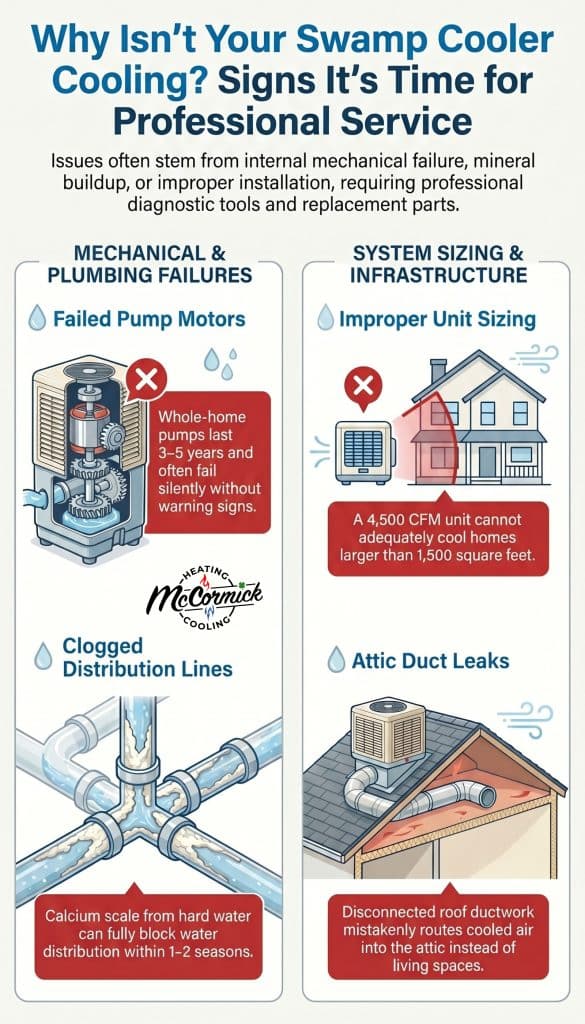
A swamp cooler that is not cooling properly after inspection typically points to one of these:
- Failed pump motor: Whole-home pump motors last 3 to 5 years and often fail silently with no obvious warning signs.
- Clogged distribution lines: Calcium scale from Greeley’s hard water can fully block distribution holes within 1 to 2 seasons.
- Undersized unit: A 4,500 CFM unit cannot adequately cool a home larger than 1,500 sq ft.
- Duct leaks: Disconnected roof ductwork routes cooled air into the attic instead of living spaces.
Mid-Season Swamp Cooler Maintenance Tips
Good swamp cooler maintenance never stops at startup.
In swamp cooler conditions in Colorado, dry heat, intense rooftop UV, and hard water, ongoing summer care is essential:
- Flush the reservoir every 2 to 3 weeks to prevent algae and mineral scale.
- Inspect pads every 30 days; replace immediately if water distribution looks uneven.
- Check belt tension monthly; new belts stretch and ‘seat’ into the pulleys during their first 24 to 48 hours of operation.
- Clear distribution tube holes with a wire brush if any pad section runs dry.
Older units over ten years old often cost more to repair than replace.
Get a free estimate to upgrade to central AC with McCormick Heating & Cooling; flexible financing available.
Key Takeaways
- Swamp cooler maintenance before the first 90° day prevents costly mid-summer emergency breakdowns.
- Always cut power and water before opening your unit; safety first, every time.
- Greeley’s Cache la Poudre-sourced hard water clogs pads and pump motors faster than most Colorado cities.
- Replace pads every season; budget $15 to $40 per set.
- A healthy pump delivers 3 to 5 gallons per minute; verify this at every startup.
- Professional tune-ups run $80–$150; McCormick has maintenance plans.
Don’t Let a 98° Greeley Day Catch You Without Cooling
The Greeley-Weld County Airport weather station records back-to-back 95°+ days starting as early as late June.
That is not when you want to discover your startup was skipped for your swamp cooler.
Schedule service in April or early May, before appointment windows disappear for weeks.
McCormick Heating & Cooling has technicians who know Greeley’s water chemistry, its neighborhoods, and its homes.
Don’t get caught on Greeley’s hottest day without cooling.
Contact McCormick Heating & Cooling to deliver accurate diagnoses and reliable swamp cooler maintenance!

FAQs About Swamp Cooler Maintenance
How do I start my swamp cooler for summer?
First, shut off power and water, then replace the pads, flush the reservoir, oil the bearings, and test the pump and float valve.
In Greeley, the ideal window for this spring startup process is mid-April to early May.
Skipping fall winterization heavily increases the risk of pump bearing failure at startup, forcing unexpected repair costs before summer begins.
How often should a swamp cooler be serviced?
Professional service is required twice annually: a spring startup in April or May and winterization in September.
Homeowners should also flush the reservoir biweekly and check pads monthly during Greeley’s peak summer heat.
At $25 a month, McCormick’s Gold Maintenance Plan covers both seasonal visits, making consistent care cheaper than one emergency repair.
Why is my swamp cooler not cooling?
A swamp cooler loses efficiency when mineral scale blocks pads, pump flow drops, or outdoor humidity exceeds 50%.
In Greeley, calcium buildup from the Cache la Poudre water supply is the leading cause, alongside stretched drive belts that reduce airflow.
A certified HVAC technician can easily resolve these performance issues or determine if the unit is simply undersized for the home.