
5-Star Reviews
Years of Local Service
Accredited Business
Technicians
and Operated
The right central cooling system depends on more than the equipment cabinet outside. Capacity, component matching, airflow, controls and duct conditions all influence how consistently the system cools the home.
McCormick Heating & Cooling assesses residential central AC systems throughout Greeley. If you already know which service you need, explore McCormick's complete air conditioning services.
What Is a Central AC System and What Are Its Parts?
A central AC system removes indoor heat through an indoor evaporator coil, moves cooled air through the home with a blower, and releases heat outdoors through the condenser. Controls, refrigerant lines, filters and ductwork keep those components working together properly.
Unlike a room unit that cools one area, central air conditioning uses a shared distribution system to deliver conditioned air to multiple rooms. Most central systems are controlled by one thermostat, although some homes use zoning controls to divide the house into separate comfort areas.
The principal components include:
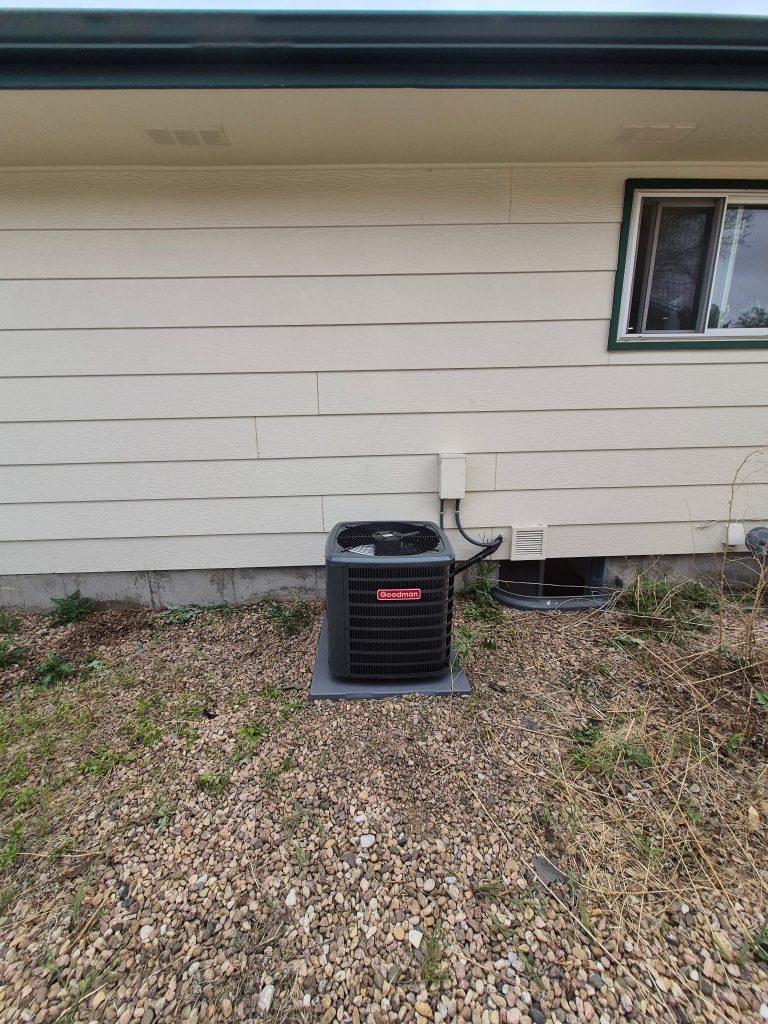
- Outdoor condenser: Contains the compressor, condenser coil and fan. It releases the heat absorbed from the home into the outdoor air.
- Indoor evaporator coil: Absorbs heat from the air as refrigerant moves through the coil.
- Blower: Moves return air across the indoor coil and delivers conditioned air through the supply ducts.
- Refrigerant lines: Carry refrigerant between the indoor coil and outdoor condenser.
- Ductwork: Distributes conditioned air and returns indoor air to the equipment.
- Thermostat and controls: Start, stop and regulate the cooling cycle based on the selected settings.
- Air filter: Helps keep airborne material from accumulating on the indoor coil and other system components.
- Condensate drain: Carries away moisture removed from the indoor air during cooling.
The outdoor condenser and indoor coil must use compatible refrigerants and form an AHRI-matched combination. Homeowners with a failure isolated to the outdoor equipment can learn more about AC condenser replacement.
What Are the Signs a Greeley Home's Central AC Is the Wrong Type or Size?
A central AC system may be the wrong type or size when rooms cool unevenly, cycles are short or long, humidity remains high, or the equipment struggles on hot days. McCormick evaluates capacity, airflow, controls, duct conditions and equipment matching.
Common concerns include:
- Short cooling cycles: Oversized equipment may satisfy the thermostat quickly without operating long enough to provide balanced comfort.
- Long or nearly continuous cycles: Undersized equipment, restricted airflow, mechanical problems or excessive heat gain can prevent the system from reaching the thermostat setting.
- Large temperature differences between rooms: Duct conditions, airflow balance, sun exposure, and home layout can produce uneven cooling.
- Hot upper floors: Rising heat, attic conditions, return-air placement, and system capacity can make upper levels harder to cool.
- High indoor humidity during operation: Equipment selection and cycle length affect how effectively the system removes moisture.
- Weak airflow from several registers: Filter restriction, blower performance, coil condition or accessible duct issues may be limiting airflow.
- A major addition that never cools properly: Added living space can change the home's cooling requirements without changing the original equipment.
- Indoor and outdoor components of different ages: Previous partial equipment changes may have left components that were not designed or rated to work together.
These signs do not prove that the original system was incorrectly selected. A repair issue can resemble a capacity problem, and poor air distribution can make properly sized equipment appear inadequate.
Greeley's 4,665-foot elevation must also be considered when assessing cooling performance. Air density affects equipment capacity and airflow, so nameplate capacity alone does not establish whether a system fits the home.
Split System vs. Packaged Unit vs. Heat Pump - Which Central System Suits Greeley?
Split systems pair indoor and outdoor components, packaged units combine major components in one cabinet, and heat pumps provide both cooling and heating. The appropriate configuration depends on the home's existing equipment, duct layout, available space, heating needs and site conditions.
Split Central AC System
A split central AC system places the condenser outside and the evaporator coil inside, commonly above or near a furnace. Refrigerant lines connect the components, while the furnace blower moves conditioned air through the home's ducts.
This configuration may suit a Greeley home that already has:
- A compatible furnace and blower
- Central ductwork
- Space for an indoor evaporator coil
- A suitable location for an outdoor condenser
Because the AC and furnace share the blower and duct system, their airflow requirements and controls must work together. The indoor coil and outdoor condenser must also be compatible rather than selected as unrelated components.
Packaged Central System
A packaged system places its primary heating and cooling components in one outdoor cabinet. Supply and return ducts connect that cabinet to the home, eliminating the need for separate indoor and outdoor cooling units.
This configuration may be appropriate when indoor mechanical space is limited or the home was designed for packaged equipment. An assessment should consider:
- The existing duct connections
- Outdoor equipment placement
- Drainage around the cabinet
- Snow and weather exposure
- Airflow and service clearances
- Access for future maintenance
A packaged system is not automatically a substitute for a split system. The home and duct layout must support its placement and airflow requirements.
Centrally Ducted Heat Pump
A centrally ducted heat pump uses a refrigeration cycle to cool the home and can reverse that cycle to provide heating. It distributes conditioned air through central ducts much like a conventional split AC system.
Whether a heat pump fits a Greeley home depends on its heating load, existing equipment, electrical capacity, controls and supplemental-heating strategy. McCormick also considers how the equipment will perform during colder outdoor conditions instead of evaluating cooling performance alone.
How McCormick Compares the Options
No configuration is universally best for every Greeley home. McCormick assesses the factors that determine whether a split system, packaged unit or heat pump is suitable, including:
- Existing heating equipment and fuel source
- Indoor and outdoor equipment space
- Duct configuration and accessible duct conditions
- Component compatibility
- Home layout and sun exposure
- Heating and cooling requirements
- Thermostat and control requirements
- Airflow at Greeley's 4,665-foot elevation
Homes without suitable central ductwork may require a different approach. McCormick's ductless mini-split systems guide explains how ductless equipment differs from central cooling.
Efficiency ratings can also help homeowners compare compatible equipment within the selected system type. Learn how current ratings are calculated in McCormick's SEER2 explanation.
What Does a Central AC System Assessment Include?
A central AC system assessment may include:
- Identifying the central AC system type
- Recording indoor and outdoor equipment models
- Reviewing component ages and condition
- Confirming refrigerant compatibility
- Checking whether the coil and condenser are AHRI-matched
- Evaluating thermostat settings and operation
- Inspecting the air filter and accessible indoor equipment
- Measuring supply and return temperatures
- Evaluating blower operation and airflow
- Measuring static pressure when appropriate
- Inspecting accessible ductwork
- Reviewing room-to-room comfort differences
- Considering home layout, exposure and recent changes
- Determining whether additional diagnostics are needed
The purpose is to establish why the system is not meeting the homeowner’s expectations. The findings may point to several different service paths:
- A system that is not operating correctly may need air conditioning repair.
- A functioning system near the end of its useful service life may warrant an AC replacement assessment.
- A home without an existing cooling system requires professional air conditioning installation.
- A correctly configured system may only need ongoing air conditioning maintenance.
McCormick explains the evidence before recommending a route. The assessment is not based solely on equipment age, outdoor-unit size or square footage.

Why Choose McCormick for Your Central AC System in Greeley?
A central AC system assessment from McCormick gives Greeley homeowners measured findings instead of assumptions. NATE-certified technicians examine how the equipment works as a complete system, explain whether its type and capacity fit the home, and route each concern correctly.
McCormick Heating & Cooling operates from 2881 S 31st Ave, Unit 3, in Greeley. Its technicians understand how local elevation, summer heat and Front Range smoke conditions affect residential cooling needs.
Homeowners choose McCormick for:
- EPA Section 608-certified technicians
- More than 800 Google reviews
- BBB A+ Accreditation since 2015
- A local Greeley headquarters
- System-wide assessments rather than single-component assumptions
- Clear routing between assessment, repair, installation and replacement
- Findings explained before work is approved
- Weekday after-hours and weekend morning availability
Central AC Systems Beyond Greeley
Central AC system assessment is available from McCormick's Greeley headquarters for homeowners throughout nearby Weld, Larimer and Boulder County communities. Technicians dispatch from 2881 S 31st Ave, Unit 3, in Greeley to evaluate central cooling performance and system configuration.
Service is available in:
Central AC System FAQs
People Also Ask
Is a Central AC System Right for Your Greeley Home?
Whether you are exploring central air for the first time or evaluating an existing system, McCormick can help you understand the available configurations. A technician will review your home, existing equipment, duct conditions, and comfort concerns, then explain the appropriate next step.