
What Is the Ideal Indoor Humidity Level?
The ideal indoor humidity level for most homes is 30% to 50% relative humidity (RH), with McCormick's technicians recommending a tighter 35% to 45% range for year-round comfort and property protection. Drop below 30%, and you'll notice static shocks, dry skin, and trim starting to crack. Climb above 50%, and windows start sweating while mold risk climbs right along with it. In Longmont's dry winter climate, that ideal indoor humidity target usually sits on the lower half of the range, and it needs to shift further as outdoor temperatures drop toward freezing.
That's the short answer. What actually determines the right number for your specific home, and why a one-size-fits-all humidity setting stops working once the mercury drops below freezing, is what separates a comfortable Longmont home from one fighting dry air all winter. If you're not sure where your home currently stands, schedule an indoor air quality assessment with McCormick Heating & Cooling, and we'll measure it for you rather than leave it to guesswork.
Why Longmont's Climate Makes Dry Air Worse
Longmont sits at roughly 4,979 feet above sea level on Colorado's Front Range, inside a semi-arid steppe climate zone. Outdoor relative humidity here regularly falls into the teens during winter cold snaps. When a forced-air furnace pulls that dry outdoor air in and heats it, its relative humidity drops even further. Warm air can hold more moisture than cold air, so heating a cubic foot of 15% RH outdoor air to 70°F indoors can push the relative humidity down into the single digits if nothing adds moisture back.
December is typically Longmont's coldest full month, with average lows near 19°F and highs around 39°F. That six-to-eight-week stretch from late November through February is when most Longmont homeowners start noticing the symptoms: throat irritation, bloody noses in kids, and static shocks every time they touch a doorknob.
Old Town & the Historic Eastside/Westside: Original Envelopes, Faster Moisture Loss
Homes in Longmont's historic Eastside and Westside neighborhoods, many built between the 1900s and 1940s near Roosevelt Park and Old Town's core, tend to have original wood-frame construction with less modern air sealing. These homes lose indoor moisture faster because the building envelope is leakier, which means humidifier equipment often has to work harder and run longer to maintain the same RH percentage compared to a tightly sealed newer build. Original wood trim and hardwood flooring in these homes are also more prone to visible shrinkage and gapping when indoor humidity drops below 30%.
Prospect New Town & Southwest Longmont: Tighter Builds, Different Humidity Behavior
On the other end, neighborhoods like Prospect New Town and the newer developments in Southwest Longmont near the Ute Creek area were built under more recent energy codes, with tighter envelopes and better window seals. These homes hold humidity more efficiently, which is good news for comfort, but it also means over-humidification is a bigger risk here. A humidistat left too high in a tightly sealed Prospect New Town home can cause window condensation and moisture buildup in wall cavities faster than it would in a leakier older house, simply because the moisture has fewer places to escape.
Signs Your Longmont Home's Humidity Has Dropped Too Low
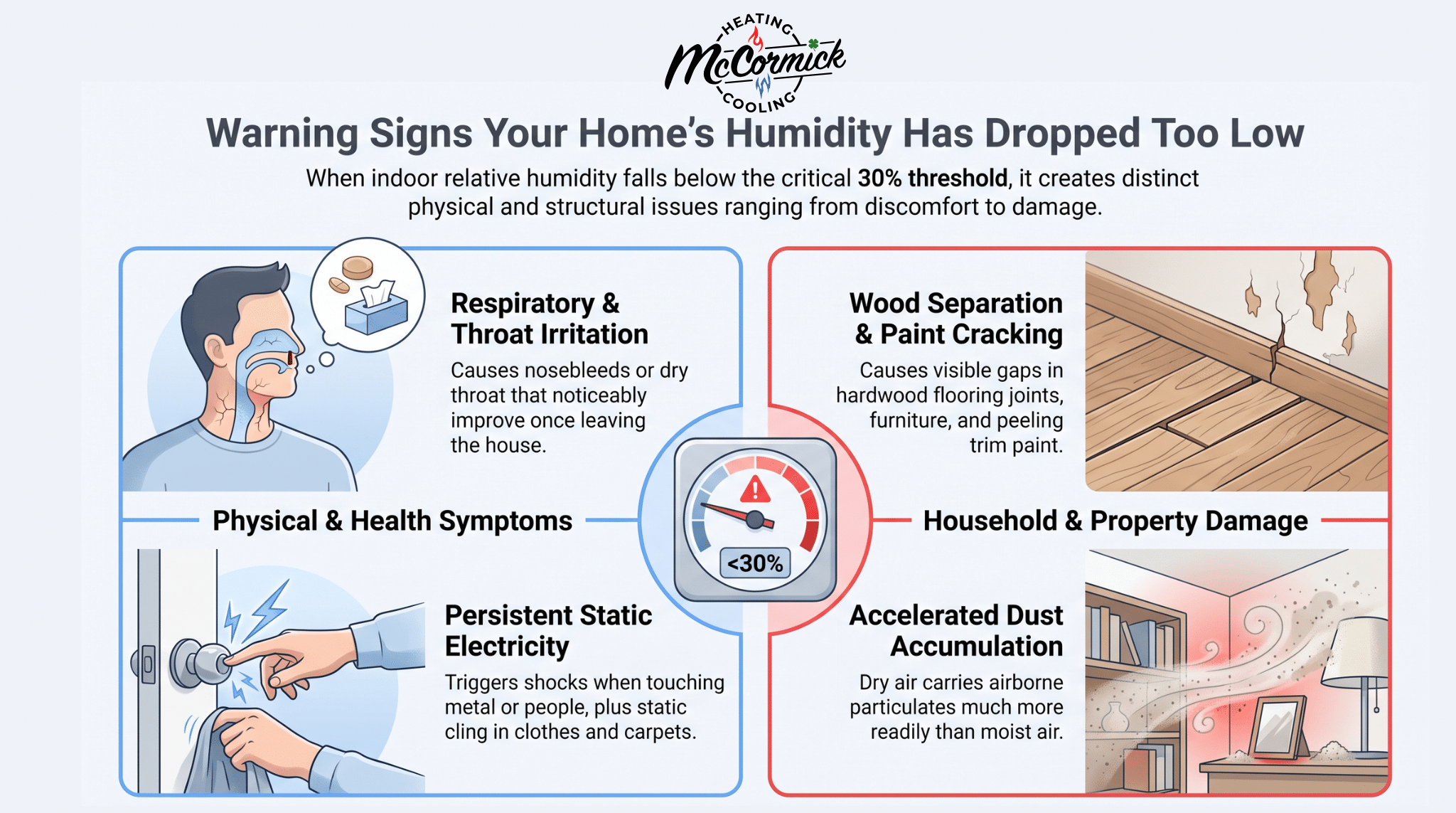
These are the physical symptoms that show up when indoor RH falls below the 30% threshold:
- Static shocks when touching metal doorknobs, light switches, or another person
- Cracked or peeling paint around trim and baseboards
- Visible gaps in hardwood flooring or wood furniture joints
- Nosebleeds or dry throat that improve when you leave the house
- Increased static cling in clothing and carpets
- Faster dust accumulation, since dry air carries particulates more readily than moist air
How to Measure Indoor Humidity Accurately
A thermostat's built-in humidity reading is often inaccurate by 5 to 10 percentage points because the sensor sits inside a single return location, not spread across the home. Here's the correct sequence for an accurate reading:
- Buy a standalone hygrometer ($10 to $25 at most hardware stores). Digital models are more reliable than analog dial versions.
- Place it away from heat sources. Keep it at least 5 feet from vents, direct sunlight, and exterior doors, which skew readings.
- Check multiple rooms. A bedroom with the door closed often reads 5 to 8 percentage points drier than an open living room near the thermostat.
- Wait 24 hours before adjusting anything. Humidity readings fluctuate with cooking, showers, and weather. A single reading isn't reliable; a 24-hour average is.
- Record readings at the same time daily for a week to establish your home's actual baseline before buying equipment.
The Humidistat Chart: What to Set Based on Outdoor Temperature
This is the piece most local guides skip, and it's the single most useful number for a Longmont homeowner trying to stop window condensation. The colder it gets outside, the lower your indoor humidistat setting needs to go, because cold window glass becomes the first surface where excess moisture condenses.
Outdoor Temperature |
Recommended Indoor RH |
What Happens If You Ignore This |
20°F to 40°F
|
40% to 45%
|
Minimal risk, comfortable range
|
10°F to 20°F
|
35%
|
Light condensation possible on single-pane windows
|
0°F to 10°F
|
30%
|
Visible fogging on older Westside/Eastside original windows
|
-10°F to 0°F
|
25%
|
Frost forms on interior glass; wood sashes absorb moisture
|
Below -10°F
|
20%
|
High risk of water damage to sills and frames
|
What Happens When Humidity Runs Too High
Overcorrecting is just as damaging as doing nothing. Two specific thresholds matter:
- Mold germination begins at approximately 65% RH, and visible growth can appear within 24 to 48 hours in a warm, dark space like a closet or behind furniture against an exterior wall.
- Dust mite populations expand rapidly above 50% RH, which matters for allergy sufferers specifically, since dust mite waste is one of the most common year-round indoor allergens.
Homeowners near the historic Westside with original wood window sashes face a specific risk: condensation sitting on cold glass for weeks at a time during a stretch of sub-zero nights can eventually rot the wood sill underneath. If you're seeing water pooling on windowsills every morning, that's your home telling you to turn the humidistat down, not up.
Comparison Table: Humidity Targets by Season and Risk Level
Season |
Target RH Range |
Primary Risk if Too Low |
Primary Risk if Too High |
Deep Winter (Dec to Feb)
|
20% to 35%
|
Static, cracked wood, nosebleeds
|
Window condensation, frost
|
Shoulder Season (Nov, Mar)
|
35% to 45%
|
Dry skin, mild static
|
Minimal, watch closet corners
|
Summer
|
30% to 50%
|
Rarely an issue in Longmont's dry season
|
Mold near AC condensate lines
|
How Longmont Homeowners Typically Correct Low Humidity
Once you've confirmed your home is running below 30% RH for more than a few days at a time, the standard fix is a whole-home humidifier installed directly on the furnace, rather than a collection of portable room units that need daily refilling. A properly sized whole-home unit ties into the same ductwork already distributing heat, so it maintains humidity across every connected room instead of just one. If you're at the point of comparing specific equipment, sizing requirements, and installation cost, the full breakdown lives on McCormick's whole-house humidifiers page.
A Longmont Case Example
Consider a 1928 craftsman bungalow two blocks from Roosevelt Park on Longmont's historic Westside. The homeowners noticed static shocks every time they touched the refrigerator door, and their hardwood floors had developed visible gaps between boards by mid-January. A hygrometer check showed indoor RH sitting at 19%, well below the 30% minimum, during a stretch where outdoor temperatures hovered near 5°F.
Using the humidistat chart above, the correct target for that outdoor range was 30%, not the 45% they'd initially guessed based on generic online advice. Because the home's original single-pane windows in the front parlor were already showing early condensation at just 25% RH, the long-term fix involved both a modest humidity increase and a conversation about weatherstripping, since the window seals themselves were contributing to uneven moisture distribution between rooms.
This is the kind of nuance a generic percentage can't capture. It's also why a technician who actually assesses your HVAC system in Longmont, airflow, and existing equipment, the same kind of visit covered on McCormick's indoor air quality services page, tends to get the setting right faster than trial and error.
Filtration Is a Separate Concern
Humidity control addresses moisture. It does nothing for dust, pollen, or wildfire smoke particles circulating through your ductwork. If you're also dealing with dusty rooms or allergy symptoms alongside dry air, that's a filtration question, not a humidity one. McCormick's MERV vs. HEPA comparison breaks down which filter rating actually fits a residential forced-air system without choking airflow.
Frequently Asked Questions
Achieve Winter Comfort Without the Guesswork
Maintaining the ideal indoor humidity during a Longmont winter requires precise adjustments based on your home's unique construction and rapidly dropping outdoor temperatures. Start by measuring your current relative humidity with a standalone digital hygrometer and benchmarking those readings against the temperature chart above to establish your home's actual baseline.
If your readings consistently fall below the 30% minimum threshold or you are battling window condensation despite standard settings, stop relying on trial and error. A properly integrated whole-home humidifier requires professional sizing and ductwork evaluation to function correctly. Schedule a comprehensive indoor air quality assessment with McCormick Heating & Cooling today, and let our expert technicians design a permanent, customized solution to protect your home and keep your family comfortable all winter long.

About Jesse Trout - Owner of McCormick Heating & Cooling
Colorado Native. HVAC Expert.
Jesse Trout is the owner of McCormick Heating & Cooling, the family-owned HVAC company that has served Greeley and Northern Colorado since 2006. A Colorado native and HVAC expert, Jesse leads the team of installers, service technicians, and front office staff who keep Northern Colorado homes comfortable year-round.
Under Jesse's leadership, McCormick's NATE/EPA-certified technicians focus on honest recommendations, transparent pricing, and equipment sized for the dry, high-altitude conditions Northern Colorado homes actually face.
Leading the team, setting the standard, and making it all happen.